
Reviewed · SCAVANGER HUNTS
e-Scavenger hunt Leuven: Explore the city at your own pace
Leuven is made for a city game. Its compact center packs Gothic stonework, old university quarters, quiet beguinages, church towers, and a famous beer tradition into an easy walking route. This self-guided Qula hunt turns those sights into a series of questions and challenges, so you explore at your own pace rather than follow a guide’s clock.
I like the freedom to pause for a terrace or shop, and I like that the route reaches corners you could easily miss on a simple walk between the main square and the Oude Markt. The main thing to consider is that this is a game first and a tour second. If you want a detailed historical talk from a live guide, choose another format.
In This Review
- Key points at a glance
- Starting at Ladeuzeplein, Leuven’s grand university square
- Town Hall and St. Peter’s Church
- The Grand Place and the old market tradition
- The Great Beguinage and the Klein Begijnhof
- The herb garden and Leuven’s botanical tradition
- University Library and Leuven’s academic identity
- Sint-Geertrui Abbey and the old city walls
- Oude Markt, the social heart of the walk
- Churches, towers, and Leuven’s smaller details
- Stella Artois and the beer connection
- How the game format affects your day
- Who will enjoy this Leuven experience most
- Should you book the Leuven e-Scavenger Hunt?
- FAQ
- Where does the Leuven e-Scavenger Hunt start?
- Where does the activity end?
- How long does the experience take?
- How many people can join one booking?
- Is a smartphone included?
- What language is offered?
- Is the activity available every day?
- Can I cancel for a full refund?
Key points at a glance

- A 2.5-hour mobile city game: The app gives you enough content for a substantial half-day outing.
- A route through Leuven’s major sights: Expect the Town Hall, St. Peter’s Church, the beguinage, university buildings, churches, towers, and old market squares.
- Flexible start and stop times: The activity is available daily from noon to midnight, and you control the pace.
- A private group of up to six: Your party plays together rather than joining a larger public group.
- Short facts with quiz challenges: The format gives you quick pieces of history, then asks you to solve tasks.
- Good value for small groups: The listed price is $37.21 per group, not per person, for up to six people.
Starting at Ladeuzeplein, Leuven’s grand university square

The game starts at Monseigneur Ladeuzeplein 17, near Leuven’s University Library. This is a sensible place to begin. Ladeuzeplein gives you a strong first look at the city’s university identity, and the library itself is one of Leuven’s most important heritage buildings.
Leuven has been linked with three different universities almost continuously since 1425. That fact helps explain the city’s character. This is not only a medieval Brabant town with churches and market squares. It is also a working student city, with academic buildings, young energy, and a long connection to books and research.
The mobile format means you need your own smartphone and data. The activity includes the city game, but not the phone or internet access. Bring a charged device, and make sure everyone in your group can hear and see the instructions. The experience is user-friendly for people with hearing impairments, since the main information arrives through the app rather than spoken commentary.
More scavanger hunts in Brussels:
- Beer Tasting and Scavenger Hunt in Brussels – About 3 Hours
★ 4.5 · 35 reviews - e-Scavenger hunt Brussels: Explore the city at your own pace
★ 4.0 · 22 reviews - Brussels Highlights Self guided scavenger hunt and Walking Tour
★ 4.0 · 14 reviews
Town Hall and St. Peter’s Church
One of the route’s strongest early sights is Leuven Town Hall on the Grand Place. Its Gothic facade is among the most famous in the world, packed with decorative detail and statues. A self-guided game cannot replace a full architectural explanation, but the quiz format gives you a reason to stop, look up, and examine the building instead of passing it as a quick photo opportunity.
Nearby, St. Peter’s Church anchors the center of Leuven. The church was built in 986 in Romanesque style, making it the city’s oldest church. That date gives the stop real weight. You are looking at a building connected to Leuven’s earliest urban story, even though the structure you see today reflects later construction and changes.
I like this part of the route because it puts Leuven’s two strongest visual themes side by side: civic power in the Town Hall and religious power in the church. The questions may be simple, but they encourage you to pay attention to details that a rushed walk can miss.
The drawback is that the app’s short facts may leave you wanting more. If medieval architecture is your main interest, use the game as a framework and allow extra time to look around on your own.
The Grand Place and the old market tradition
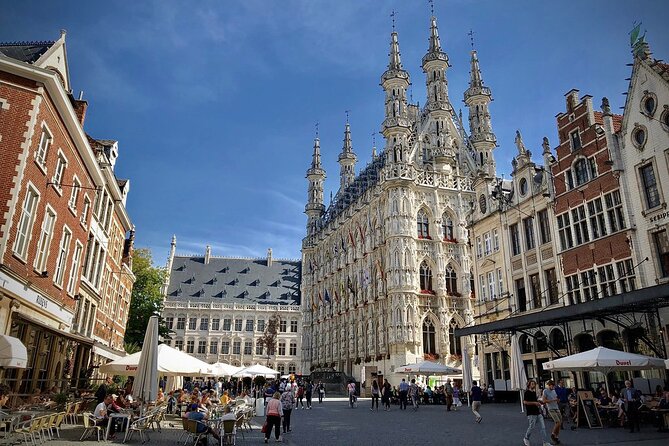
The route also introduces the older economic life of Leuven. As the residence city of the Counts of Leuven, the square received market rights in 1150. Markets could be held as often as three times a week, helping turn the center into a place of trade and daily business.
This is the sort of background that works well in a city game. You do not need a long lecture to understand why the square matters. A few lines about market rights, followed by a question, connect the paving stones and surrounding buildings with the practical life that once filled them.
For you, the useful point is that the game mixes major sights with context. It is not simply a checklist of buildings. You get small facts about why a square, tower, or gate was important, then continue moving through the city.
The Great Beguinage and the Klein Begijnhof
The Great Beguinage is one of the most atmospheric sections of the route. It dates to the 13th century, and during its peak in the 17th century, about 360 beguines lived there. Beguines were women who lived in religious communities without taking formal vows as nuns. Their presence shaped Leuven’s streets, houses, and social life for centuries.
The beguinage is a place where you should slow down. Its lanes and buildings create a quieter mood than the central squares. The game helps you reach it, but you will get more from the stop if you put the phone away for a few minutes and simply notice the setting.
The route also includes the Klein Begijnhof, first mentioned in 1272. This smaller district consisted of one street and two cul-de-sacs where women connected with the nearby Sint-Geertrui Abbey lived. It is exactly the kind of place a standard first walk might skip.
I especially like the contrast between the two beguinages. The Great Beguinage gives you a larger, more recognized historic quarter. The Klein Begijnhof offers a smaller, less obvious stop. Together, they show that Leuven’s religious communities were not confined to one postcard view.
A few more Brussels trips to weigh up
- Brussels: City Highlights Walking and Tasting Tour
★ 4.9 · 505 reviews - Brussels: City Highlights and Hidden Gems Bike Tour
★ 4.8 · 344 reviews - From Brussels: Guided Antwerp City Tour
★ 4.3 · 177 reviews - Brussels: City Center Guided Food Tour with Tastings
★ 4.8 · 174 reviews
The herb garden and Leuven’s botanical tradition
Another stop is Leuven’s herb garden, part of the oldest botanic garden in Belgium. Its official name is the Hortus Botanicus Lovaniensis.
This is a welcome change from churches, squares, and university facades. The garden gives the route a quieter outdoor pause and adds a scientific side to Leuven’s story. It also fits the city’s university character. Leuven’s old institutions were concerned not only with theology and philosophy, but also with plants, medicine, and study.
Do not expect the experience to function like a guided garden visit. The supplied information does not promise a live botanist or a long explanation of the plant collections. Think of it as a stop that broadens the walk and gives you another setting for the game’s questions.
University Library and Leuven’s academic identity
The University Library on Ladeuzeplein is another major landmark. Leuven has served as a university city for centuries and has also been home to important university libraries. The library building gives that history a grand physical presence.
Starting near the library makes practical sense because the route begins with a clear landmark and easy public transport access. It also sets up the rest of the experience: you are not simply touring a medieval center, but moving through a city shaped by students, scholars, religious institutions, and commerce.
I would not book this activity only for the library if you want to go inside. The experience focuses on the outdoor city route and interactive tasks. Its value is in linking the library with the wider city, not in providing a dedicated library visit.
Sint-Geertrui Abbey and the old city walls
The former abbey church of Sint-Geertrui is one of Leuven’s five medieval parish churches. It sits outside the first city wall, between the Dijle and Mechelsestraat. That location matters because it shows how Leuven extended beyond its earliest defensive boundary.
The Klein Begijnhof and Sint-Geertrui church work well together in the itinerary. One introduces the women who lived near the abbey, while the other provides the religious and urban setting around them. You get a more complete picture by seeing both rather than treating each as an isolated monument.
The route also reaches the Romanesque gate dating from 1218 to 1222. It is the only remaining piece of the Sint-Elisabethgasthuis, founded around 1080 to 1090 under Henry III, Count of Leuven. A surviving gate can seem modest beside a huge church or ornate Town Hall, but this is where the game format earns its keep. It draws your attention to a fragment that might otherwise blend into the street.
Oude Markt, the social heart of the walk
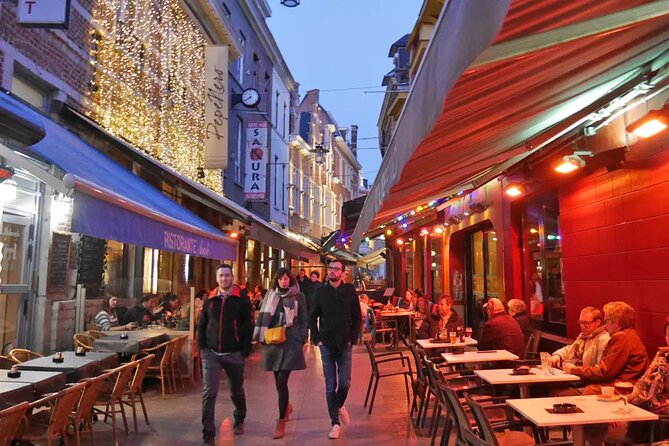
The Oude Markt is Leuven’s famous meeting square, lined with a remarkable number of cafés and catering establishments. It is often described as the longest bar in Europe, a playful nickname that captures the square’s social role.
This is the best place to use the activity’s flexible timing. You can pause for a drink or meal, then return to the game when you are ready. The route is not built around a fixed departure time, so you do not have to hurry past the square while the rest of your group wants to sit down.
That flexibility is a real benefit for families and mixed-age groups. Older children can take part in the questions, adults can enjoy the setting, and nobody has to keep pace with a guide. The competitive element also gives groups a reason to stay engaged rather than letting one person do all the navigating.
The limitation is simple: the game may encourage you to focus on answers when the square deserves a relaxed look. I would treat the quiz as a prompt, not a race.
Churches, towers, and Leuven’s smaller details
The route includes another church begun around 1440. Its description refers to three naves, two strongly projecting transepts with blind longitudinal walls, and a choir with a heptagonal apse. Even if you are not an architecture specialist, these details give you a reason to inspect the shape of the building rather than just note its name.
St. James’s Church adds a different lesson. From the Romanesque church dating from the early 13th century, only the tower remains. Its ornate 1478 bell is counted among the seven wonders of Leuven.
A partial church can tell you as much as a complete one. The stop helps you notice how cities preserve pieces of buildings, not always entire monuments. The game’s short-and-sweet approach is useful here because it gives you just enough information to make the tower worth a closer look.
At Janseniuspark, the Jansenius and Justus Lipsius towers mark another surviving piece of the medieval city. They once flanked a water gate in the city wall, where ships entered Leuven. This stop connects the town to the Dijle and to the movement of goods by water.
You might find this section more rewarding than the headline sights. It is not as instantly recognizable as the Town Hall, but it explains how Leuven worked as a defended and trading city.
Stella Artois and the beer connection
Leuven is also the home of Stella Artois. The brewery remains rooted in the city and is part of AB InBev, one of the world’s largest brewing groups.
The route’s brewery stop adds modern local identity to the medieval and university material. Leuven is not a museum set. It is a living city with an international beer name tied to its local past.
The game can introduce that connection, but it does not promise a brewery tour or tasting. Keep your expectations focused on the city walk. If beer production is your main reason for visiting, confirm separately what is available at the brewery, since it is not listed as part of this activity.
How the game format affects your day
The app contains about 2.5 hours of content, while the full activity is estimated at two to four hours. That range is useful. A fast group can keep moving, while a slower group can stop at the Oude Markt, browse shops, or spend longer in the beguinages and gardens.
This is a private activity for a maximum of six people. The price is $37.21 per group, so a full group of six pays roughly $6.20 each. Even with two people, the shared price can be reasonable if you want a flexible half-day walk rather than a scheduled private guide.
You are responsible for the smartphone and data. That is the main practical cost beyond the booking price. A charged phone is essential, and a second device could be useful if your group wants to split up briefly or keep the questions visible while another person navigates.
The activity is offered in English. It is available Monday through Sunday from noon until midnight during the stated operating period. Confirmation arrives at booking, and service animals are allowed. The starting point is near public transport, and most people can participate.
Free cancellation is available if you cancel at least 24 hours before the local start time. Changes or cancellations made later are not accepted for a refund.
Who will enjoy this Leuven experience most
I would choose this for friends, couples, families with older children, and small groups who like solving questions together. The competitive side adds energy without requiring a formal team-building event.
It also suits you if you already know Leuven. The route includes famous places, but it also points you toward smaller corners such as the Klein Begijnhof, old gates, church remnants, and the towers by Janseniuspark. Familiar cities often reveal more when a route gives you a reason to turn down a side street.
I would be more cautious if you want a deep historical explanation, interior access, or a personal conversation with a local guide. There is no named guide because there is no live guide. The app supplies the structure, facts, and challenges.
The experience received a 4.4 rating from 21 reviews, with 90 percent recommending it. The strongest pattern is clear: the game helps people find places they might not reach on their own, and the short facts do not weigh down the walk. The one important objection is also clear: some people expect a traditional tour and find a game instead.
Should you book the Leuven e-Scavenger Hunt?
Book it if you want a flexible, playful way to cover Leuven’s major sights and overlooked corners. The group pricing is strongest for four to six people, and the ability to stop at the Oude Markt or take breaks makes it easier to fit into a relaxed day.
Skip it if you want a guide speaking continuously about architecture, politics, and church art. This is a city game with historical content, not a conventional walking tour.
For the right group, it is a smart way to spend half a day: begin near the University Library, follow the clues through Leuven’s squares and churches, pause when something catches your eye, and let the city provide the backdrop for a friendly contest.
FAQ
Where does the Leuven e-Scavenger Hunt start?
It starts at Monseigneur Ladeuzeplein 17, 3000 Leuven, Belgium.
Where does the activity end?
The activity ends back at the meeting point.
How long does the experience take?
The estimated duration is two to four hours. The app includes about 2.5 hours of content.
How many people can join one booking?
One private group of up to six people can participate.
Is a smartphone included?
No. You need to bring your own smartphone and data.
What language is offered?
The experience is offered in English.
Is the activity available every day?
Yes. It is listed as available Monday through Sunday, from 12:00 AM to 11:59 PM, during the stated operating period.
Can I cancel for a full refund?
Yes, if you cancel at least 24 hours before the experience start time. Later cancellations and changes are not accepted for a refund.
Just added around Brussels
- Standard vehicle from Brussels airport to city of Antwerp★ 5.0 · 4 reviews
- Private transfer from BRU Airport to Brussels city with luxury limousine 3 pax★ 4.5 · 8 reviews
- Luxury vehicle from Brussels airport to the city of Brussels★ 4.0 · 5 reviews
- Transfer Brussels Airport –> City MB E Class 1-3 PAX (ONE WAY)★ 5.0 · 6 reviews
- PRIVATE MPV TRANSFER FROM/TO BRUSSELS AIRPORT (Max 6 pax) ONE-WAY★ 5.0 · 4 reviews
- Transfer Brussels Airport (BRU) –> City Center 7 PAX (ONE WAY)★ 5.0 · 7 reviews
- Transfer Brussels Airport –> Brussels MB V Class 7 PAX (ONE WAY)★ 5.0 · 4 reviews
- Brussels: City Walk with Audioguide in 7 Languages on your Phone★ 3.5 · 4 reviews
Scavanger Hunts, compared.

e-Scavenger hunt Antwerp: Explore the city at your own pace
Read our review →
e-Scavenger hunt Bruges: Explore the city at your own pace
Read our review →
Bruges Scavenger Hunt and Highlights Self Guided Audio Tour
Read our review →
Beer Tasting and Scavenger Hunt in Brussels – About 3 Hours
Read our review →
e-Scavenger hunt Mechelen: Explore the city at your own pace
Read our review →
e-Scavenger hunt Hasselt: Explore the city at your own pace
Read our review →
e-Scavenger hunt Brussels: Explore the city at your own pace
Read our review →Browse the lists this tour appears in