
Reviewed · BRUSSELS TOURS
Excursion to Bruges and Ghent by bus from Brussels
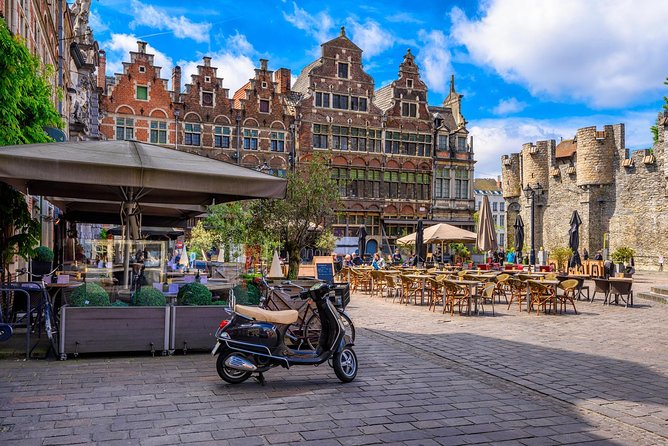
Bruges and Ghent offer two very different views of medieval Belgium in one long day. Bruges gives you canals, tiny lanes, romantic bridges, and picture-book squares. Ghent feels bigger, more open, and more lived-in, with grand towers, a riverfront, and the imposing Castle of the Counts. The contrast is the real point of the trip.
I like the efficient round-trip coach service, which saves you the trouble of arranging two separate train journeys. I also like the Spanish-language guiding, especially when the guide explains small details such as Bruges’ beer trade, the dragon atop Ghent’s belfry, or why the Van Eyck painting in Saint Bavo’s Cathedral has been stolen so many times. The tradeoff is clear: ten and a half hours sounds generous, but two cities and long guided walks leave limited time for museums, meals, and wandering on your own.
In This Review
- Key points to know before booking
- Why Bruges and Ghent work well together
- Arriving in Bruges at Minnewater Lake
- Bruges canals, bridges, and old institutions
- Burg Square and the most photographed Bruges views
- Chocolate tasting and Bruges free time
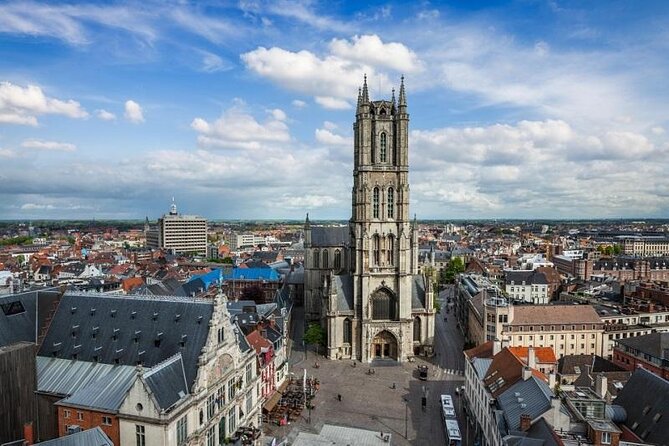
- Ghent begins with towers and civic power
- Ghent’s churches, guild houses, and riverfront
- Meat markets, cuberdons, and the last free hour
- Guide quality, group size, and audio equipment
- What the $54.45 price really covers
- Who should book this day trip
- Should you book it?
- FAQ
- Where does the tour start?
- What time does the excursion begin?
- How long does the tour last?
- Is transportation included?
- Is the tour conducted in Spanish?
- How much free time do I get in each city?
- Are meals and drinks included?
- Can I use my own headphones for the radio guide?
Key points to know before booking
- Two medieval cities in one day: See Bruges and Ghent without changing hotels or planning separate transport.
- Bruges is the more scenic stop: Expect canals, Minnewater Lake, Beguinage courtyards, Burg Square, and the famous Rozenhoedkaai view.
- Ghent has more urban scale: Its cathedral, belfry, guild houses, riverfront, and Castle of the Counts create a stronger sense of a working city.
- Spanish-language guidance: Guides including Guiomara, Eduardo, Unai, Irene, Carlos, Ana, Paula, and Alexa have led recent departures.
- Free time is limited: Plan your priorities before arrival. You cannot see every museum and enjoy a relaxed meal in both cities.
- Budget-friendly transport: At $54.45 per person, the price covers the coach, guide, and guided walks, but not food, drinks, hotel pickup, or attraction admission.
Why Bruges and Ghent work well together
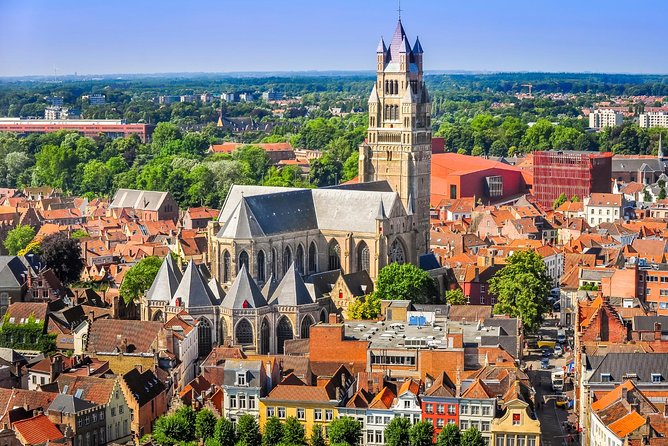
Bruges and Ghent are close enough to combine, but they do not feel alike. Bruges is compact and polished, with a medieval center built around canals and handsome public squares. Ghent is larger and less purely postcard-like. Its historic core mixes old guild buildings and churches with the energy of a modern city.
That difference helps the day feel varied. In Bruges, I would focus on atmosphere, architecture, and photographs. In Ghent, I would pay closer attention to the city’s religious art, civic power, trade, and riverfront buildings.
The coach makes the day simple. You meet at Carrefour de l’Europe in central Brussels at 8:30 a.m., then ride in an air-conditioned bus. The maximum group size is 45 people, so this is not an intimate private walk. It is a practical group outing with a professional guide, set departure times, and a return to the same Brussels meeting point.
The long day is the main cost. You will spend substantial time walking and following the group’s pace. Still, for a first visit to Belgium, the ability to see both cities without handling train schedules can be worth more than the extra independence of traveling alone.
Other Brussels days worth putting on the list:
- Brussels: Atomium Entry Ticket with Design Museum Ticket
★ 4.4 · 9,254 reviews - From Brussels: Guided Day Trip to Bruges and Ghent
★ 4.6 · 8,353 reviews - From Brussels: Bruges & Ghent Day Tour – 2 Fairytale Cities
★ 4.7 · 8,242 reviews
Arriving in Bruges at Minnewater Lake
The first Bruges stop is Bargeplein, also called Katelijnparking, where you have about ten minutes for a bathroom break. From there, the walk begins at Minnewater Lake, known as the Lake of Love.
This is a smart introduction to Bruges. The lake gives you a calm view before the narrow lanes and busy squares begin, and the guide explains the local love story connected with it. You get only about five minutes here, so treat it as a quick orientation and photo stop rather than a restful pause.
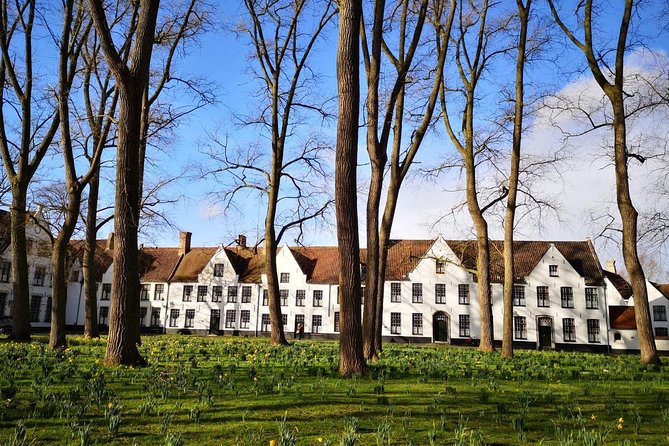
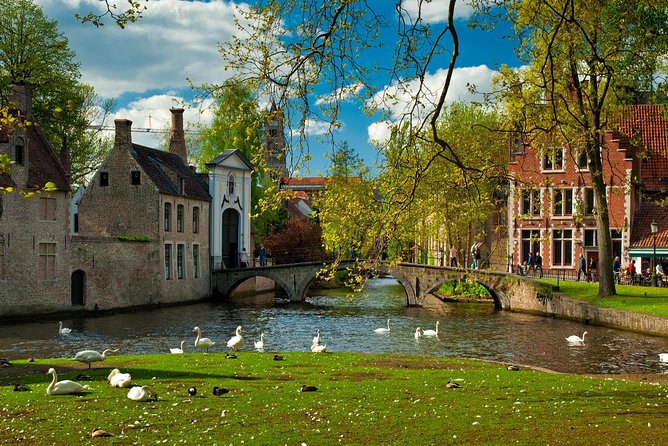
Next comes the Beguinage, or Begijnhof, founded in 1245. This quiet complex recalls the beguines, women who lived in religious communities without taking formal monastic vows. The stop is short, around ten minutes, but it adds social history to the usual procession of churches and wealthy merchant houses.
You then pass along Stoofstraat, where the guide points out original medieval homes. At Walplein, the subject shifts to Bruges beer. This is one of the tour’s useful small touches. Instead of only identifying buildings, the guide connects the city’s squares and houses to everyday work, trade, and local drinking customs.
Bruges canals, bridges, and old institutions
The St. Bonifacius Bridge is one of the prettiest spots on the walk. You have time for photographs while hearing the legend associated with the bridge. Bruges has no shortage of photogenic corners, but this one feels more intimate than the grand Markt.
At the Old St. John’s Hospital, the guide explains how medieval health care operated. The hospital building itself is a reminder that Bruges was not just a display of wealthy facades. It was also a place where ordinary people became ill, sought help, worked, worshiped, and died.
Across from the hospital is the Church of Our Lady. The guide discusses the Michelangelo sculpture of the Virgin and Child inside, but this portion is primarily an exterior explanation. If seeing the sculpture matters to you, check how much independent time you have and ask the guide about entering. The church is not presented as a full included visit.
The Gruuthusemuseum stop introduces the powerful Gruuthuse family. Again, the walk provides context without turning into a museum visit. That approach suits a day covering two cities, but it means you should not expect extended indoor sightseeing.
Burg Square and the most photographed Bruges views
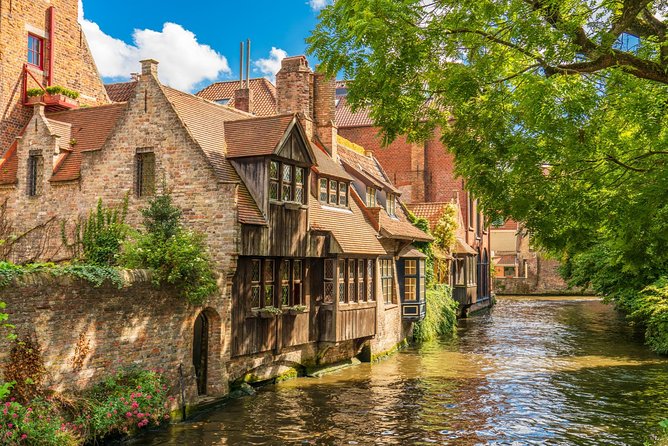
Burg Square packs several major sights into one stop. The Gothic Town Hall, the former courthouse, and the Basilica of the Holy Blood face the square. The guide explains the buildings and their roles, giving you a useful framework before your free time.
The Basilica of the Holy Blood is especially important to many visitors, but the schedule allows about ten minutes in the square rather than a long visit inside. If you want to enter churches or see interiors at a slower pace, you will need to use your free time carefully.
From Burg, the walk continues to Rozenhoedkaai, often called the Quay of the Roses. This is Bruges’ signature canal view, the place that appears in countless photographs. You get a few minutes for pictures and an explanation of the site’s past. Bring a phone or camera that is ready to use because the stop is brief.
At Huidenvettersplein, or Tanners Square, the guide explains how medieval tanners worked. The square’s name gives you a direct link to the crafts that once supported Bruges. It is a modest stop, but these short explanations make the walk more than a parade of attractive buildings.
The guided Bruges portion ends at the Markt, the large central square. Here you learn about the buildings around the square and receive suggestions for food, traditional chocolate, and shopping. The guide also gives clear instructions for returning to the bus and continuing to Ghent. Pay attention here. A vague memory of the meeting time is not enough when the coach is leaving for another city.
Same old town, a completely different kind of day:
- Choco-Story Brussels: Chocolate Museum Entrance with Tasting
★ 4.3 · 4,883 reviews - Bruges and Ghent – Belgium’s Fairytale Cities – from Brussels
★ 4.0 · 4,809 reviews - Brussels: Hop-On Hop-Off Bus Tour
★ 4.0 · 4,016 reviews - Brussels: Entry Ticket to Mini-Europe
★ 4.5 · 2,870 reviews
Chocolate tasting and Bruges free time
The stop at Chocolalino adds a short artisan chocolate tasting. The guide discusses Bruges chocolate and offers tips for telling handmade products from industrial ones. This is an eight-minute stop, so think of it as a sample and an introduction, not a full chocolate workshop.
After the guided walk and tasting, you have roughly one to one and a half hours of free time, depending on traffic and the group’s pace. That is enough for a quick lunch, a canal-side stroll, a few shops, or a short look inside a church. It is not enough for a relaxed exploration of every lane and museum.
I would decide in advance what matters most. If you want photographs, use the free period to revisit Rozenhoedkaai or explore around the Markt. If you want food, do not spend the entire break comparing menus. If you want a museum, confirm its location and opening arrangements before the day begins.
At about the agreed time, return to Bargeplein. The guide and bus meet you there for the transfer to Ghent. The coach portion is useful because it removes the need to navigate between the two city centers, but the schedule leaves little room for delays.
Ghent begins with towers and civic power
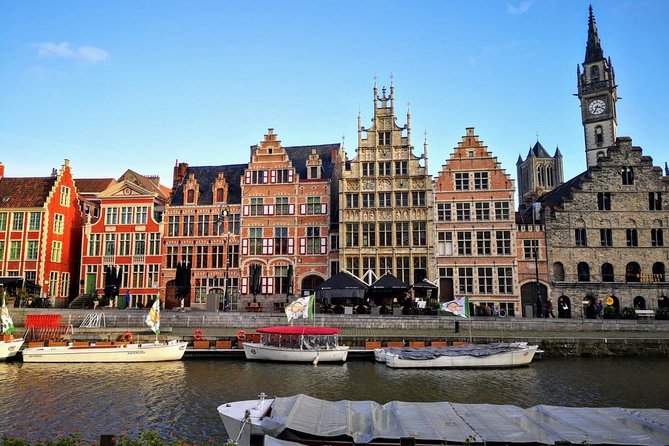
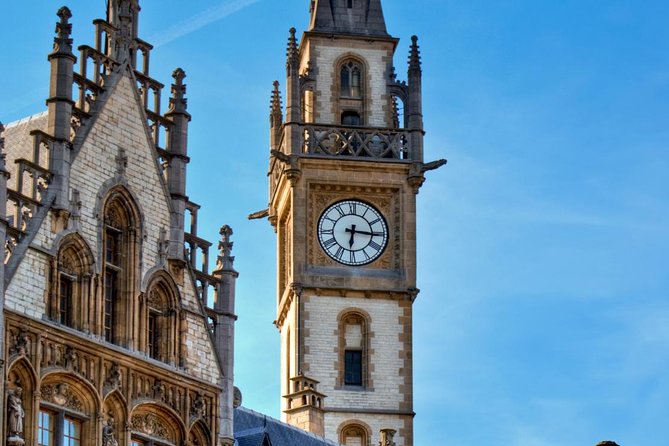
After arriving in Ghent, you walk toward the center for the second guided tour. The first major stop is Ghent Town Hall, where the guide points out the building’s different architectural styles. That mixture reflects the city’s long development and gives you an immediate lesson in how public buildings change over time.
The Ghent Belfry follows. The guide explains the tower and the dragon associated with it. The dragon is one of the city’s memorable symbols, and the story gives personality to what could otherwise be just another tower photograph.
Saint Bavo’s Cathedral receives the longest scheduled stop, about 25 minutes. You see the exterior and interior, and the guide explains the famous Adoration of the Mystic Lamb by Hubert and Jan van Eyck. The painting has an extraordinary record of theft and recovery, which makes the cathedral visit more engaging than a simple art-history lecture.
Because the cathedral is an active religious building, timing and access can vary. The important point is that this tour includes the cathedral as part of the guided visit, unlike some Bruges stops that are explained mainly from outside. If the Van Eyck altarpiece is high on your list, stay close and use the cathedral time well.
Ghent’s churches, guild houses, and riverfront
The tour continues to Saint Nicholas Church, with a short explanation that Belgian churches also host concerts and events. Then you see the Masons’ Guild Hall and learn how guild houses worked. Their decorated fronts are not random ornament. They reflect the trades and civic groups that shaped the city.
At Korenmarkt, the guide explains the history of the former post office building. This square is one of Ghent’s main central spaces, and the stop helps connect the buildings around it to more recent city life.
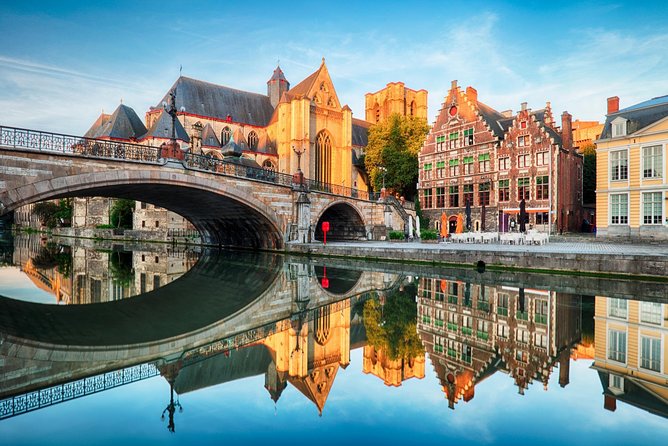
St. Michael’s Bridge is the best broad-view stop in Ghent. You can photograph the church tower, the surrounding historic buildings, and the river corridors from one place. The tour allows about seven minutes here, so you will want to take pictures quickly before the group moves on.
Then the walk follows the Lys River to Graslei and Korenlei. The guide identifies buildings such as the Grain House and the building now used as the Marriott Hotel. This waterfront is one of Ghent’s most memorable areas, with old commercial facades lining the water.
Compared with Bruges, Ghent’s riverfront feels larger and more connected to a city that still functions as a place of work and residence. You get the old architecture, but not only as a preserved scene. That is why some visitors prefer Ghent to Bruges, even though Bruges is the more instantly romantic city.
Meat markets, cuberdons, and the last free hour
The walk reaches the 15th-century Meat House, once a covered market. The stop explains how the building was used, giving you another link between architecture and food trade.
At Kleine Vismarkt, a traditional street stall introduces cuberdons, a well-known Ghent sweet. You have only a few minutes here, but it is a useful local detail and a chance to try something associated specifically with the city.
The final guided stop is Sint-Veerleplein. The guide explains the square and nearby buildings, then gives suggestions for eating and souvenirs. You also receive the return instructions for Brussels. As in Bruges, write down the meeting time and location if needed. Do not rely on finding the guide by chance later.
Ghent gives you about one to one and a half hours of free time. Some visitors use it for food, others for another walk along Graslei and Korenlei. You might also use it to return to a church or square that caught your attention during the guided walk.
The day ends with the bus ride back to Carrefour de l’Europe in Brussels. The total duration is about 10 hours and 30 minutes, though traffic can affect the exact return time.
Guide quality, group size, and audio equipment
The strongest part of the experience is the human guiding. Guides named in recent departures include Guiomara, Eduardo, Unai, Irene, Carlos, Ana, Paula, and Alexa. The feedback consistently highlights friendly service, clear historical explanations, and guides who stay attentive to the group.
That does not guarantee which guide you will receive, but it tells you what kind of service the operator aims to provide. Some guides are especially praised for explaining details carefully and helping with practical questions. One guide was described as recovering lost time after a late departure, which is reassuring, though delays remain possible.
The maximum group size of 45 is worth considering. A group this large can make canal bridges, narrow lanes, and meeting points feel crowded. It also means you should remain aware of the guide’s position and keep track of the agreed departure time.
Belgian regulations sometimes require a radio guide system. You may use your own wired headphones with a 3.5 mm jack, but wireless headphones are not accepted. If you do not have suitable headphones, disposable ones cost €1. This is a tiny extra expense, but bringing compatible wired earphones can save time and waste.
What the $54.45 price really covers
At $54.45 per person, the tour offers solid value if you want transport and orientation more than museum depth. You are paying for a full-day air-conditioned coach, a Spanish-speaking professional guide, guided walks in both cities, and practical food and shopping suggestions.
Food and drinks are not included. Hotel pickup and return are not included either, so you must reach the Brussels meeting point at Carrefour de l’Europe. Attractions are not presented as separate included admissions, and several Bruges sights are explained from the outside.
The price is less attractive if you prefer to set your own pace. A train-based day trip could give you more freedom, but it would require planning, transfers, and separate research. Here, the trade is simple: less independence in exchange for less logistical work.
Who should book this day trip
I would recommend it to first-time visitors based in Brussels who want a broad introduction to Flanders. It also fits families and couples who prefer a guide, a set schedule, and direct transport between cities.
Spanish-speaking visitors should find the format particularly useful. The guide explains both city walks in Spanish, including the stories behind the buildings and local foods. The tour also suits anyone who wants to compare Bruges and Ghent before deciding where to return for a longer stay.
I would hesitate if you dislike early starts, long walking days, or short stops. You may also feel rushed if you want to visit several museums, sit down for an extended meal, or explore beyond the central sights. One poor experience involved an inexperienced driver and a very slow transfer, while another complaint focused on an uncomfortable bus and unclear return instructions. Those problems do not describe the general experience, but they are fair reasons to keep expectations practical.
The operator offers free cancellation up to 24 hours before the start time. The excursion can also be changed or refunded if poor weather or an insufficient number of participants causes cancellation.
Should you book it?
Book this excursion if you want the easiest way to see both Bruges and Ghent from Brussels, especially with Spanish-language guidance. You will get the key squares, canals, churches, towers, riverfront views, and enough free time for a quick meal or independent walk.
Skip it if you want a slow Bruges visit or serious museum time. For most first visits, though, the $54.45 price is reasonable for two city tours and round-trip transport. Go in knowing that it is a fast introduction, not a leisurely stay, and you will get much more from the day.
FAQ
Where does the tour start?
The tour starts at Carrefour de l’Europe, Carr de l’Europe, 1000 Brussels, Belgium.
What time does the excursion begin?
The scheduled start time is 8:30 a.m.
How long does the tour last?
The excursion lasts approximately 10 hours and 30 minutes.
Is transportation included?
Yes. Round-trip transportation from Brussels is provided by air-conditioned coach.
Is the tour conducted in Spanish?
Yes. The experience includes a professional Spanish-speaking guide and guided walks in both Bruges and Ghent.
How much free time do I get in each city?
You receive approximately one to one and a half hours of free time in Bruges and the same amount in Ghent. The exact time can vary with traffic and the pace of the group.
Are meals and drinks included?
No. Food and drinks are not included, but the guide provides suggestions for places to eat.
Can I use my own headphones for the radio guide?
Yes, but they must be wired headphones with a 3.5 mm jack. Wireless headphones are not accepted. Disposable headphones are available for €1 if needed.
Just added around Brussels
- Standard vehicle from Brussels airport to city of Antwerp★ 5.0 · 4 reviews
- Private transfer from BRU Airport to Brussels city with luxury limousine 3 pax★ 4.5 · 8 reviews
- Luxury vehicle from Brussels airport to the city of Brussels★ 4.0 · 5 reviews
- Transfer Brussels Airport –> City MB E Class 1-3 PAX (ONE WAY)★ 5.0 · 6 reviews
- PRIVATE MPV TRANSFER FROM/TO BRUSSELS AIRPORT (Max 6 pax) ONE-WAY★ 5.0 · 4 reviews
- Transfer Brussels Airport (BRU) –> City Center 7 PAX (ONE WAY)★ 5.0 · 7 reviews
- Transfer Brussels Airport –> Brussels MB V Class 7 PAX (ONE WAY)★ 5.0 · 4 reviews
- Brussels: City Walk with Audioguide in 7 Languages on your Phone★ 3.5 · 4 reviews
Brussels Tours, compared.
Atomium Entry Ticket with Design Museum Ticket
Read our review →
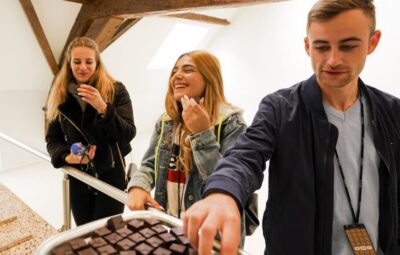
Choco-Story Brussels: Chocolate Museum Entrance with Tasting
Read our review →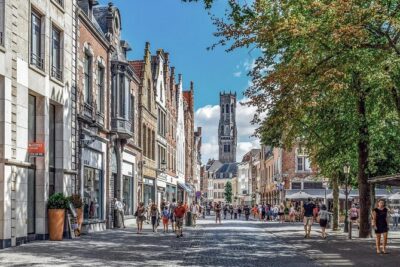
Bruges and Ghent – Belgium’s Fairytale Cities – from Brussels
Read our review →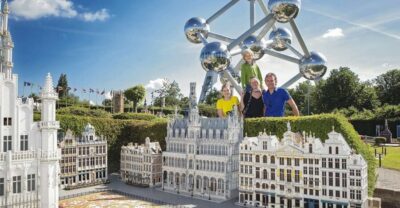

Belgian Chocolate Making Workshop with Tastings
Read our review →
Browse the lists this tour appears in