
Reviewed · WALKING TOURS
Brussels: 2-hours “Art Nouveau” Walking Tour
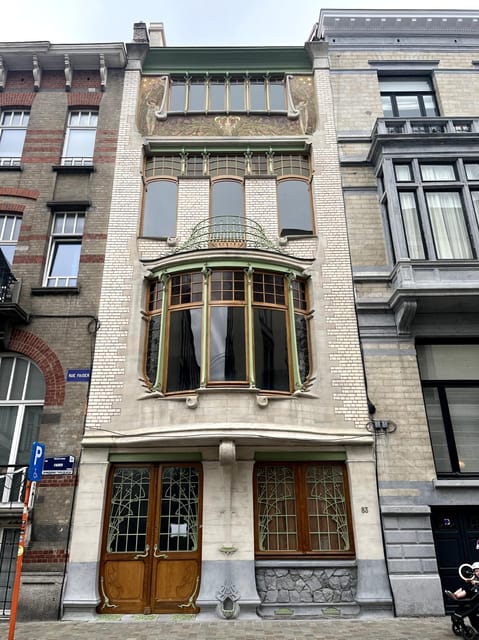
Brussels is one of the best places in Europe to see Art Nouveau in its original setting, and this private tour links together buildings you would struggle to find on your own. You’ll move from the Cinquantenaire area toward Saint-Gilles, seeing work by Victor Horta and other major architects along the way.
I like the clear introduction to the movement and the chance to compare several Art Nouveau trends in one outing. I also like the small private format, which lets you ask questions and focus on the buildings that interest you most. The main caution is that the advertised walking format may not always match the actual outing: one recent participant was driven between sites, while others had the walking experience they expected.
In This Review
- Key points
- Why Brussels is the right city for Art Nouveau
- Meeting at Merode and beginning at Cinquantenaire
- Maison Cauchie and the pleasure of close looking
- Palais Stoclet and a different kind of modernity
- Maison Saint Cyr, Maison Van Dyck, and the smaller details
- Hôtel van Eetvelde and Victor Horta’s design language
- Maison Roosenboom and Hôtel Ciamberlani
- Maison Hankar, Maison Hannon, and the wider list of stops
- How the two-hour format affects the experience
- Is $136 a fair price?
- Who should book this Brussels Art Nouveau tour?
- Booking advice and final decision
- FAQ
- How long is the Brussels Art Nouveau tour?
- Where does the tour begin?
- Where does the tour finish?
- What language is the tour offered in?
- Is this a private tour?
- What is included in the price?
- Are transport tickets included?
- Is the tour suitable for wheelchair users?
- Can I cancel the booking?
Key points
- Horta’s Brussels work: See the Hôtel van Eetvelde, Hôtel Tassel, Maison and Atelier Horta, and other buildings linked to Victor Horta.
- A broad architectural survey: Compare Maison Cauchie, Palais Stoclet, Maison Saint Cyr, Maison Hankar, Maison Hannon, and more.
- A private English-language tour: The group is private, so you can ask questions without keeping up with a large crowd.
- A route across several districts: The tour begins at Merode and finishes in Saint-Gilles, covering more ground than a single-neighborhood walk.
- Guides with different strengths: Yves, Davit, David, and Eric have led recent departures, with especially strong praise for passion and clear explanations.
- A practical meeting point: Meet outside Brasserie Carpe Diem, opposite the Merode metro station exit.
Why Brussels is the right city for Art Nouveau
Art Nouveau was not imported into Brussels as a ready-made tourist style. The city helped give birth to it in the late 19th century, when architects began rejecting stiff historic models and looking for a more modern visual language.
On this tour, you start with that story before setting off. Your guide explains the features that made Art Nouveau feel new at the time: flowing lines, plant-inspired shapes, unusual ironwork, decorative façades, carefully designed entrances, and a close relationship between architecture and interior design.
That short introduction matters. Without it, you may see a curved balcony or a curling façade and simply label it pretty. With the basic vocabulary in hand, you can ask why the architect used the curve, how the windows control light, or how decoration is built into the structure instead of pasted on afterward.
I especially like the promise of comparing different Art Nouveau trends. Brussels was not home to one single look. Some buildings feel light and organic, while others are more geometric, formal, or theatrical. A tour that places them side by side gives you a better sense of the movement than a single house museum can.
A few more Brussels trips to weigh up
- Brussels: Historical Walking Tour with Chocolate & Waffle Tasting
★ 5.0 · 1,165 reviews - Brussels Walking and Tasting Tour (Beers,Chocolates&Fries/Waffle)
★ 5.0 · 929 reviews - Brussels Chocolate Walking Tour and Workshop
★ 4.5 · 885 reviews
Meeting at Merode and beginning at Cinquantenaire
The meeting point is in front of Brasserie Carpe Diem, opposite the Merode metro station. Merode has three different exits, so use the product-page photo when finding the correct one. This is a useful detail, since choosing the wrong exit can waste the first part of a short tour.
The tour begins near the entrance to Parc du Cinquantenaire. The park itself is the first listed stop, with about 15 minutes set aside for a guided introduction. You should expect this opening to be more about context than a long architectural inspection.
From here, your guide sets the stage for Brussels as the birthplace of Art Nouveau. You’ll hear how the style emerged, what made it modern, and how its main branches differ. Since the whole experience lasts only two hours, this opening is concise, but it gives the rest of the route a clear purpose.
The park location is also practical. It puts you near the Merode metro station at the beginning, while the final stop is in Saint-Gilles. You are not simply circling one monument. You are following a route across different parts of Brussels, which helps show how widely the style spread through the city.
Maison Cauchie and the pleasure of close looking
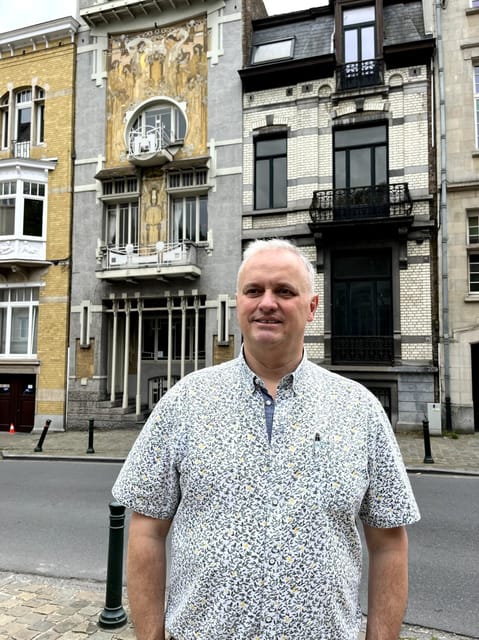
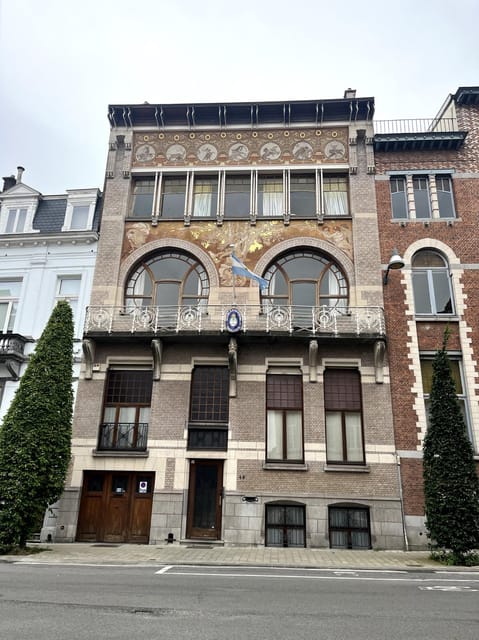
Maison Cauchie is one of the memorable façades on the route. It is known for the decorative character of its exterior, and it gives you an early chance to see how Art Nouveau combines architecture with graphic design and ornament.
This is where a guide can make a real difference. If you are walking alone, you might photograph the façade and move on. Your guide can point out the parts that define the building’s style and explain how decorative elements work with the structure.
Do not expect every named building to be an interior visit. The experience is described as a walking tour of Art Nouveau buildings, not as a program of museum entries. The value comes mainly from seeing the exteriors in their neighborhoods and hearing how the buildings fit into the larger movement.
Palais Stoclet and a different kind of modernity
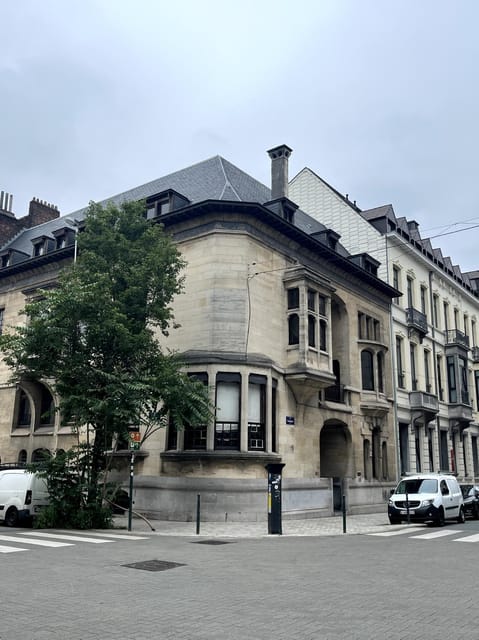
The Palais Stoclet offers a useful contrast with the more curving, plant-like side of Art Nouveau. Its inclusion helps show that the movement could also be controlled, geometric, and highly formal.
That contrast is one of the strongest reasons to choose a specialist tour rather than a general city walk. You are not just collecting famous façades. You are learning that Art Nouveau had several visual directions, and that two buildings from the same period can feel entirely different.
The program does not state that you enter Palais Stoclet, so plan to view it from outside. You should also understand that access to private buildings can vary. The route is subject to availability and may change, so the exact selection of stops is not guaranteed.
Same old town, a completely different kind of day:
- Brussels: Atomium Entry Ticket with Design Museum Ticket
★ 4.4 · 9,254 reviews - From Brussels: Guided Day Trip to Bruges and Ghent
★ 4.6 · 8,353 reviews - From Brussels: Bruges & Ghent Day Tour – 2 Fairytale Cities
★ 4.7 · 8,242 reviews - Choco-Story Brussels: Chocolate Museum Entrance with Tasting
★ 4.3 · 4,883 reviews
Maison Saint Cyr, Maison Van Dyck, and the smaller details
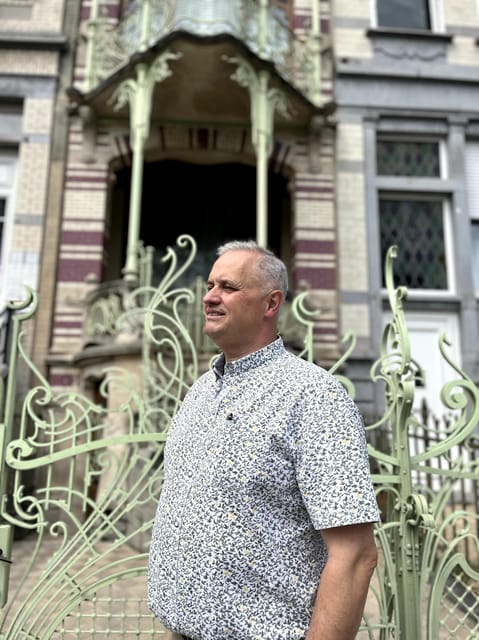
Maison Saint Cyr and Maison Van Dyck add more variety to the route. These houses help fill in the picture between the best-known Horta buildings and the grander addresses.
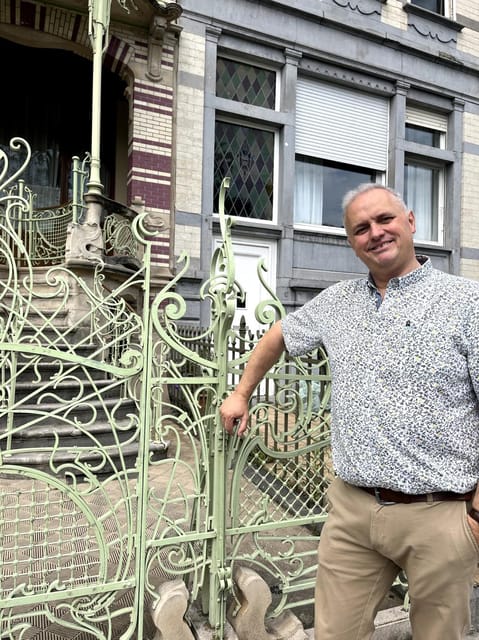
I like this part of the program because it promises more than a short list of celebrity architects. Art Nouveau is also found in doorways, window frames, balconies, stonework, and narrow urban façades. The smaller houses can reveal how the style worked at a more personal scale.
Your guide’s explanations are especially useful here. Several guides have been praised for clear and passionate presentation, including Davit, David, and Eric. Yves has also led the tour, and one participant credited him with going beyond the planned route by taking the group by car to see more.
The different guide names are worth noting because the experience may feel slightly different depending on who leads it. Davit was described as passionate, David as informed and articulate, and Eric as someone who made the afternoon engaging. One person had a very different experience and found the architectural explanations weak, so I would treat the guide quality as a real part of the booking decision rather than a minor detail.
Hôtel van Eetvelde and Victor Horta’s design language
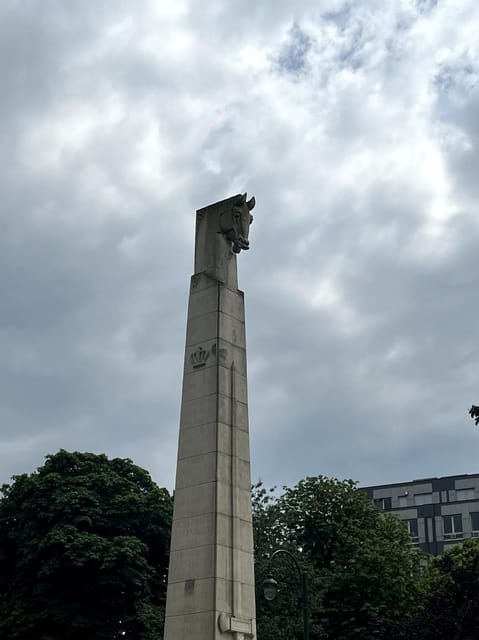
The Hôtel van Eetvelde is one of the key Horta buildings included in the program. Horta is central to any serious look at Brussels Art Nouveau, and seeing several of his projects lets you compare his recurring ideas instead of judging him from one address.
The tour also lists Hôtel Tassel, Maison and Atelier Horta, and the house of Horta’s brother. Together, these stops create a more complete portrait of his work. You can look for repeated design habits while also noticing how each commission responds to its site and purpose.
Horta’s buildings are valuable because the style does not stop at the street façade. His approach treated the building as a whole, with structure, stairs, ironwork, windows, and decoration working together. Even if you only see the exterior, the guide can help you imagine the logic behind the design.
If you plan to visit the Horta Museum separately, this tour could make that visit more rewarding. One recent participant specifically found that seeing the city’s other Art Nouveau buildings gave extra meaning to the museum visit. The museum itself is not included in the tour, so you need a separate admission and visit plan.
Maison Roosenboom and Hôtel Ciamberlani
Maison Roosenboom and Hôtel Ciamberlani continue the route into the more residential side of Brussels. Hôtel Ciamberlani is listed as a 15-minute guided stop and is also the final named architectural stop before the tour ends.
These addresses matter because they show how Art Nouveau was woven into ordinary city streets. You are not spending the whole two hours at one grand monument. You are seeing a sequence of façades, each with its own balance of structure and ornament.
The route then finishes on Avenue de la Jonction in Saint-Gilles. That ending is useful to know before you book. You will not return to Merode, so allow time afterward to get where you need to go. The information provided does not specify the exact transport arrangement between every district, and one participant reported being driven rather than walking the full route.
Maison Hankar, Maison Hannon, and the wider list of stops
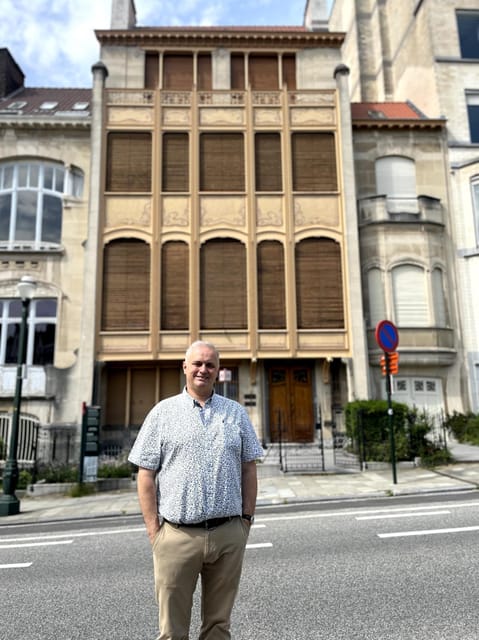
The full program also names Hôtel Ciamberlani, Maison Hankar, Maison Hannon, and the Maison associated with Horta’s brother. These stops broaden the architectural story beyond Horta alone.
Paul Hankar is important to the development of Brussels Art Nouveau, and including his work helps you compare different approaches within the same city. Maison Hannon adds another notable address, while the additional houses keep the tour from becoming a single-architect biography.
The number of named buildings may sound ambitious for two hours. That is both a strength and a limitation. You cover a lot, but you should not expect a long stop at every address or a full lecture on each one. The experience works best as a guided survey, giving you a map of the movement and a list of places to revisit if you have more time.
How the two-hour format affects the experience
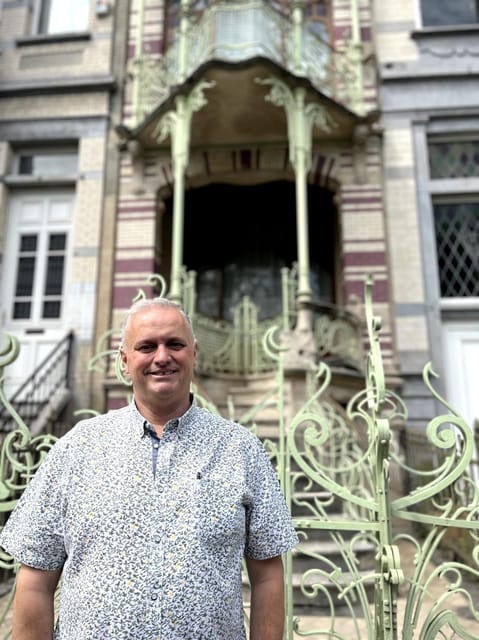
Two hours is enough for a focused introduction and a good selection of buildings, but it demands a brisk pace. You’ll spend much of the time moving between stops, listening outdoors, and pausing for photographs.
The private format helps. You can ask your guide to explain a detail, repeat a point, or spend more time on a building that catches your eye. A large group would make those adjustments harder.
The route also covers several areas, so comfortable shoes are sensible even though the distance is not specified. The tour is not suitable for wheelchair users, and smoking is not allowed. Transport tickets are not included if public transport is needed.
The biggest practical issue is the difference between the advertised format and the actual route. The experience is presented as a walking tour, but one participant described being driven around in a car, while another said Yves used his car to show more than expected. This may reflect a route change, guide choice, or availability issue, but you should ask for clarification if the walking format is important to you.
Is $136 a fair price?
At $136 per person, this is not a bargain city stroll. The price makes more sense if you value a private guide, a specialist subject, and access to a long list of buildings that would be difficult to locate and understand alone.
A general Brussels walking tour usually gives you major central sights and broad city context. This experience is narrower and more specialized. You are paying for Art Nouveau expertise, a route across several districts, and the ability to ask questions in a private group.
The value depends heavily on the guide. Strong explanations can turn a series of façades into a clear architectural lesson. A weak guide, especially on a subject as specialized as this, could make the price feel high. The uneven experience described by participants makes this worth considering before booking.
You can reduce the risk by treating the tour as a starting point for your own Art Nouveau day. If the guide gives you useful context and a list of buildings to revisit, the experience can improve a separate Horta Museum visit and help you explore Brussels with sharper eyes.
Who should book this Brussels Art Nouveau tour?
I would choose this tour if you already care about architecture, design, urban history, or decorative arts. It also suits anyone who wants to see more than the Grand Place and the usual central sights.
It is a good fit for you if:
- You want a private English-language experience.
- You enjoy comparing buildings rather than visiting only one museum.
- You are comfortable spending two hours outdoors and moving between districts.
- You want to see Horta alongside Hankar, Cauchie, Stoclet, Saint Cyr, and other architects.
- You plan to visit the Horta Museum and want more context first.
I would hesitate if you need a strictly predictable walking route, require step-free access, or want to enter each building. The tour is not suitable for wheelchair users, and the route may change with availability.
Booking advice and final decision
Book this if Art Nouveau is a main reason for your Brussels visit and you want a private guide to connect a large number of scattered buildings. The strongest part of the experience is its subject: Brussels gives you a rare chance to see the movement in the streets where it developed.
Before paying, confirm the meeting point, the guide’s planned route, and whether the outing will be on foot or partly by car. That small check matters because two hours passes quickly, and the ending in Saint-Gilles is away from the starting point at Merode.
The tour includes a professional guide and the Art Nouveau walking experience. Transport tickets are not included, and building entry is not listed. You can cancel up to 24 hours in advance for a full refund, or reserve now and pay later, which gives you some flexibility.
My call: book it for focused architectural context and a private format, but go in expecting an exterior-focused survey rather than a series of interior visits. If your guide is as clear and engaged as Davit, David, Eric, or Yves were described, the tour can give you a much better eye for Brussels.
FAQ
How long is the Brussels Art Nouveau tour?
The tour lasts two hours. Starting times depend on availability.
Where does the tour begin?
Meet in front of Brasserie Carpe Diem, opposite the Merode metro station exit. Merode has three exits, so use the meeting-point photo to identify the correct one.
Where does the tour finish?
The tour finishes on Avenue de la Jonction in Saint-Gilles, Belgium.
What language is the tour offered in?
The live tour guide speaks English.
Is this a private tour?
Yes. The group type is private.
What is included in the price?
The price includes a professional guide and the guided Art Nouveau tour of Brussels buildings.
Are transport tickets included?
No. Transport tickets are not included if they are needed.
Is the tour suitable for wheelchair users?
No. The experience is not suitable for wheelchair users.
Can I cancel the booking?
Yes. You can cancel up to 24 hours in advance for a full refund. You can also reserve now and pay later.
Just added around Brussels
- Standard vehicle from Brussels airport to city of Antwerp★ 5.0 · 4 reviews
- Private transfer from BRU Airport to Brussels city with luxury limousine 3 pax★ 4.5 · 8 reviews
- Luxury vehicle from Brussels airport to the city of Brussels★ 4.0 · 5 reviews
- Transfer Brussels Airport –> City MB E Class 1-3 PAX (ONE WAY)★ 5.0 · 6 reviews
- PRIVATE MPV TRANSFER FROM/TO BRUSSELS AIRPORT (Max 6 pax) ONE-WAY★ 5.0 · 4 reviews
- Transfer Brussels Airport (BRU) –> City Center 7 PAX (ONE WAY)★ 5.0 · 7 reviews
- Transfer Brussels Airport –> Brussels MB V Class 7 PAX (ONE WAY)★ 5.0 · 4 reviews
- Brussels: City Walk with Audioguide in 7 Languages on your Phone★ 3.5 · 4 reviews
Walking Tours, compared.
Walking Tour, Canal Boat Trip w/Beer Tasting Option
Read our review →

Historical Walking Tour with Chocolate & Waffle Tasting
Read our review →
Brussels Walking and Tasting Tour (Beers,Chocolates&Fries/Waffle)
Read our review →
Browse the lists this tour appears in