
Reviewed · SCAVANGER HUNTS
e-Scavenger hunt Kortrijk: Explore the city at your own pace
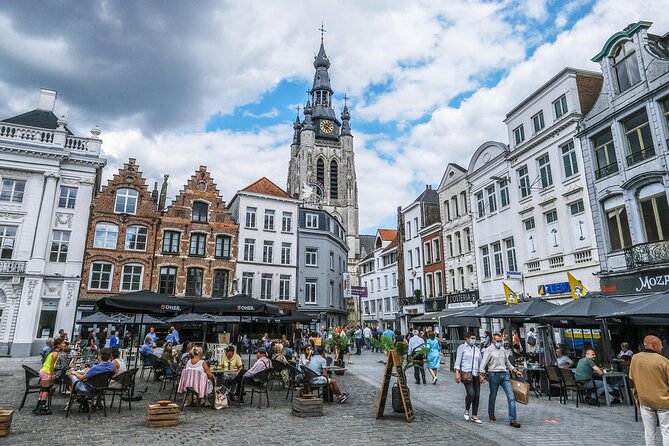
Kortrijk’s best sights are scattered across its old center, and this self-guided smartphone game gives you a reason to connect them. You’ll move from medieval towers and beguinage cottages to museums, churches, monuments, and shopping streets while answering questions along the way.
I like the freedom to stop for coffee, change your pace, or take a longer look at a landmark. I also like the price: $37.33 covers a private group of up to six, so a full group pays little per person. The main caution is technical. You need your own smartphone and data, and GPS problems or building work can make some clues harder to solve.
In This Review
- Key points to know before you book
- A playful way to meet Kortrijk
- The Beguinage and the first medieval clues
- Towers, cloth, and the Lys Valley
- Churches that reveal different sides of the city
- Battle monuments and the making of public memory
- Courtyards, care, and quieter corners
- Parks, roses, and a change of pace
- Shopping streets and the modern city
- How the app and scoring affect the day
- Is $37.33 good value for six people?
- Who should choose this Kortrijk city trail?
- Should you book the Kortrijk e-scavenger hunt?
- FAQ
- Where does the activity start?
- Where does the activity finish?
- How long does the scavenger hunt take?
- How many people can join one booking?
- Is the activity guided?
- Is a smartphone included?
- What language is offered?
- Can children take part?
- Is the activity available every day?
- Can I cancel for a refund?
Key points to know before you book

- Kortrijk’s medieval core: See the Beguinage, Belfry, Artillery Tower, Lys River towers, and historic churches in one self-guided route.
- A game with real sightseeing value: Questions encourage you to inspect statues, façades, courtyards, and monuments rather than simply walk past them.
- Good for small private groups: One booking covers up to six people, with no guide or other group joining you.
- Flexible timing: Plan on roughly 2 to 4 hours, with the freedom to pause whenever you want.
- Bring working technology: A smartphone and mobile data are not included, and GPS may not always behave as expected.
- Useful for families and repeat visitors: The questions suit children, and even people familiar with Kortrijk can notice new details.
A playful way to meet Kortrijk

The activity begins at Stationsplein 6, beside Kortrijk station, and returns to the same meeting point. That makes the start easy to reach by public transport and gives you a clear finish, though you should allow time to get comfortable with the app before setting off.
This is not a walking tour led by a person. Instead, the app sends your team toward city sights and gives you questions or assignments to complete. You decide how quickly to move and when to stop. If you are traveling with friends, the competitive side can add some energy. You can also play as a relaxed family walk.
I would not treat the game as a substitute for a full museum visit or a detailed historical lecture. Its strength is the combination of movement, observation, and short facts. You get enough context to understand why a place matters, then continue before the pace becomes heavy.
The route takes about 2 to 4 hours. That range matters. A quick team focused on points may finish closer to two hours, while a family stopping at courtyards, churches, shops, and museums will need longer. The app does not lock you into a rigid schedule, so the longer option is easy.
More scavanger hunts in Ghent:
- e-Scavenger hunt Ghent: Explore the city at your own pace
★ 4.5 · 41 reviews - e-Scavenger hunt Ostend: Explore the city at your own pace
★ 4.5 · 10 reviews - e-Scavenger hunt Mons: Explore the city at your own pace
★ 5.0 · 4 reviews
The Beguinage and the first medieval clues
One of the most rewarding parts of the route is Kortrijk’s Beguinage. It dates from the 13th century and has been a UNESCO World Heritage Site since 1998. Its small houses and enclosed courtyard offer a quieter change from the main streets.
The Beguinage was destroyed several times, including during the Battle of the Golden Spurs in 1302, after the Battle of Westrozebeke in 1382, and again by the French in 1684. The 41 cottages you see today date mainly from the 17th century. That repeated destruction gives the site a practical, lived-in feel rather than a perfectly preserved storybook appearance.
You can stroll past the cottages, enter the courtyard, and visit the Mattheuskapel. The game works well here because the details are close at hand. Look carefully at the houses, chapel, and layout before answering. If your group rushes, you may miss the point of the stop.
The nearby Kortrijk 1302 museum occupies the former Groeninge Abbey in Beguinage Park. Its multimedia presentation deals with the Battle of the Golden Spurs and the way that battle became part of Kortrijk’s public memory. The museum adds depth to the monuments and gates you see later, though the activity does not replace time inside the museum if you want a fuller visit.
Towers, cloth, and the Lys Valley
The route then links Kortrijk’s military and commercial past. The towers are built from limestone and sandstone, and the southern Speytorre dates to 1385. Its role was to control traffic on the Lys. That detail helps you read the riverfront as a working defensive and trade area, not just a pleasant place for photographs.
Texture, Kortrijk’s flax and linen museum, explains how flax was cultivated, processed, and made into fabric. The story is tied to the Lys Valley around Kortrijk, where water, agriculture, and textile work shaped the local economy.
You may find this one of the more useful stops if you want to understand why Kortrijk grew as it did. Medieval buildings are easy to admire without asking what paid for them. The flax connection supplies that missing piece. Check the opening situation before relying on an indoor museum visit, since the game’s route and the museum’s ability to admit visitors are separate matters.
The Belfry rises in the center of the Grote Markt. It was part of the former cloth hall, first mentioned in 1248. This is a good place to pause and look at the square as a commercial space. The tower is not just a vertical landmark. It points to the importance of cloth production and trade in Kortrijk’s past.
Churches that reveal different sides of the city
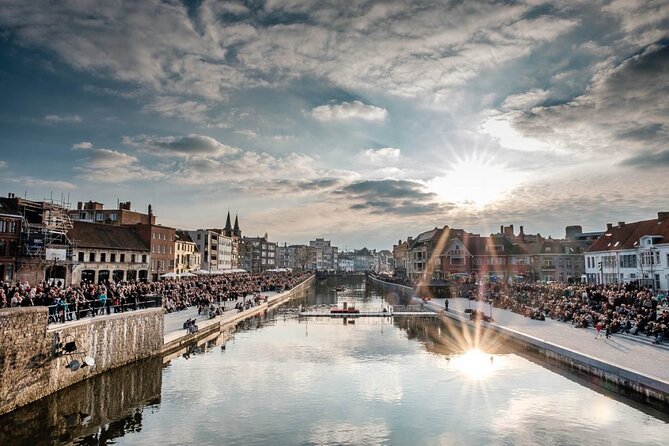
The Church of Our Lady began in 1199 on the initiative of Count Baldwin IX. It stood within Kortrijk’s grave domain, a reminder that church buildings were closely tied to rulers, burial, and civic power.
St. Martin’s Church, or Sint-Maartenskerk, occupies a site used for worship as early as around 650. The present church gives the game one of its clearest visual anchors. Its history reaches far beyond the medieval period, so pay attention to the contrast between an ancient religious site and the modern city around it.
Another stop is the church of the Passionists, built in 1874. It is described as an archetypal church of popular devotion. That makes it a useful counterpoint to the older churches. The route does not present Kortrijk as one single medieval display. Instead, you see religious buildings from different periods and get a sense of how worship continued to shape ordinary neighborhoods.
The Town Hall brings another visual challenge. Its façade belongs to the Gothic-Renaissance transition, and 14 statues represent the counts of Flanders. One puzzle asks you to count the Flemish counts. Pay close attention to what the question actually asks, since the statues and nearby figures can make the answer unclear. This is a small but important lesson for the game: inspect the wording and the site rather than guessing quickly.
A few more Ghent trips to weigh up
- Ghent: 40-Minute Historical Boat Tour of City Center
★ 4.3 · 430 reviews - Ghent: Guided City Tour with Food Tastings
★ 4.8 · 228 reviews - Ghent: City Highlights and Hidden Gems Guided Bike Tour
★ 4.7 · 196 reviews - Ghent: Guided City Tour with Chocolate Tastings
★ 4.8 · 36 reviews
Battle monuments and the making of public memory
Kortrijk gives the Battle of the Golden Spurs a large public presence. The Groeningepoort is a triumphal arch built for the 600th anniversary of the battle. The Groeningemonument was created for the same commemoration.
The nearby Kortrijk 1302 museum helps explain how the battle became a powerful part of local identity. Seeing the museum, gate, and monument in one outing lets you compare historical events with later public storytelling. That is more interesting than treating each monument as an isolated photo stop.
The Artillery Tower, also called the Armorie Tower, dates to the castle built in 1301 and 1302 by the French King Philip the Fair during the conflict with the Count of Flanders. Its presence adds a harder military edge to a route otherwise filled with churches, houses, and shopping streets.
I like this section for the way it makes you look twice. A city monument often tells you as much about the time when it was built as about the event it honors. The app’s short questions encourage that kind of attention, even if they cannot provide a full lecture on the subject.
Courtyards, care, and quieter corners
Baggaertshof was founded in 1638 by Joossine Baggaert, who established 13 cottages for women in need. It offers a more personal view of historic Kortrijk than a major church or monument does. You can think about housing, charity, and community life while moving through a compact site.
The hospital’s inner courtyard is one of the best-preserved 17th-century sites in Kortrijk. The word hospital originally referred to hospitality, not illness. That small language detail gives the location extra meaning. It points to a place of welcome and care before modern medical institutions took their current shape.
These quieter stops are where the scavenger hunt earns its keep. Without a prompt, you might walk past a courtyard or charitable foundation while heading toward the main square. The questions make you slow down and search for details.
There is a practical issue here. Some answers depend on being able to see a statue, sign, façade, or architectural feature clearly. Construction work has sometimes blocked views around Kortrijk, so you should be ready to use judgment if a clue is temporarily hidden.
Parks, roses, and a change of pace
Not every stop is medieval. The park named after Queen Astrid commemorates her visit to Kortrijk on April 5, 1935. It gives the route a civic and green-space break after the denser historic streets.
The International Rose Garden dates from 1959 and lies in the grounds of Castle ’t Hooghe along Doorniksesteenweg. Its location may make it feel different from the central sights. The garden is a useful reminder that Kortrijk’s attractions include planned parks and horticultural spaces as well as old stone buildings.
Because the route can last up to four hours, these open-air sections help vary the walk. You can take a slower look, rest, and reset before continuing. The supplied information does not promise that every attraction is open during your visit, so consider the rose garden and museums as route highlights rather than guaranteed indoor admissions.
Shopping streets and the modern city
The game also includes K in Kortrijk, a shopping center in the heart of town with more than 80 shops and restaurants spread over 34,000 square meters. Ring Shopping, on Kortrijk’s outskirts, has about 90 shops and focuses on fashion, beauty, and lifestyle goods.
These stops may seem less historic, but they show how the city works today. K in Kortrijk is easy to combine with the central sights. Ring Shopping is different because it sits outside the old core and represents a more modern retail zone.
For a history-focused outing, these locations may feel like the least compelling parts of the route. For families or mixed groups, they can be useful. One person can browse while another takes a break, and restaurants provide a natural pause during a long walk. The app treats the city as a whole, not as a collection of monuments sealed off from daily life.
How the app and scoring affect the day
The app gives your team directions and questions. The questions are generally suitable for children, and the varied assignments can make familiar streets feel new. You may find yourself counting statues, checking architectural details, or looking for an overlooked feature instead of walking straight to the next major sight.
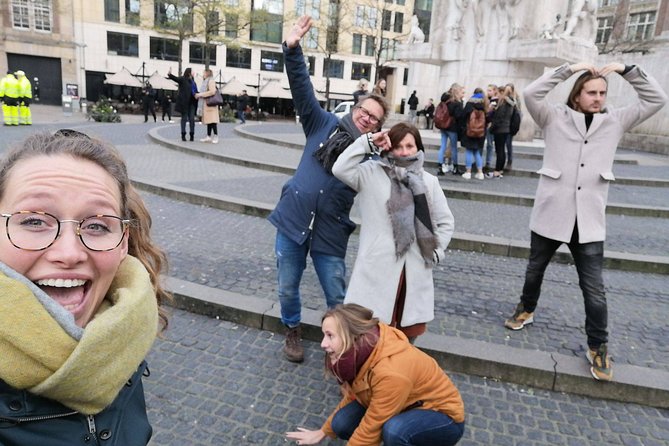
The competitive element works best with two small teams or a group that enjoys friendly rivalry. A larger family group can split into teams, though the booking is limited to six people. If you prefer a calm walk, simply treat points as optional and use the questions as prompts.
Technology is the weak link. You supply the smartphone and data, and the GPS function may not always work properly. If navigation fails, you may need to trace locations through Google instead. That can cost time and, in the game system, points or sound effects. Bring a charged phone and keep the route flexible.
The app is offered in English. The activity is private, and no guide joins your group. Service animals are allowed, and the experience is described as suitable for most participants and user-friendly for people with hearing impairment. The route itself includes city streets, courtyards, parks, and landmark areas, but no detailed mobility information is provided, so check the route directly if access is a major concern.
Is $37.33 good value for six people?
At $37.33 per group of up to six, the mathematics are favorable for a full party. Six people pay a little over $6 each before any extra costs such as food, museum entry, or transport. Even a pair pays about $18.67 each, which is still reasonable for a 2 to 4 hour private activity.
The value comes from the structure. You get a route, an app, questions, and a reason to visit both famous sights and less obvious corners. You do not pay for a live guide, scheduled commentary, or included admissions. If you want expert answers on every church and monument, another tour would suit you better.
I see this as especially good value for families, friend groups, and repeat visitors who want a flexible activity. It is less attractive if you dislike phone-based games or want to spend most of the day inside museums.
You can cancel for a full refund up to 24 hours before the local start time. Changes or cancellations within 24 hours are not refunded.
Who should choose this Kortrijk city trail?
I would choose it for a first visit when I want an overview without following a guide’s fixed pace. It also suits people who already know Kortrijk. One participant who grew up in the city still found new details, which is a useful sign that the questions do more than point out the obvious.
Families should find the child-friendly questions helpful. Couples and friends can use the game to add purpose to a walk. The private format is also useful if your group has different interests, since you can pause at shops, restaurants, courtyards, or churches without holding up another party.
I would hesitate if your phone battery is unreliable, your data connection is limited, or you want guaranteed access to every indoor attraction. I would also avoid booking it as a timed activity immediately before another appointment. The 2 to 4 hour range is broad, and navigation problems or construction can slow you down.
Should you book the Kortrijk e-scavenger hunt?
Book it if you like learning through small challenges and want to cover a wide range of Kortrijk sights at your own speed. The Beguinage, Belfry, Lys towers, churches, flax museum, battle monuments, courtyards, parks, and modern shopping areas create a varied route rather than a simple march through the main square.
Skip it if you prefer a guide who explains every detail in person or if you do not want to depend on GPS. For most small groups, though, the low group price, private format, and flexible timing make this a practical way to get oriented. Bring mobile data, allow extra time, and treat the score as a bonus rather than the whole point of the day.
FAQ
Where does the activity start?
It starts at Stationsplein 6, 8500 Kortrijk, Belgium.
Where does the activity finish?
The activity ends back at the meeting point.
How long does the scavenger hunt take?
The expected duration is approximately 2 to 4 hours.
How many people can join one booking?
One group can include up to six people.
Is the activity guided?
No. It is a private, self-guided activity played through an online app on your phone.
Is a smartphone included?
No. You must bring your own smartphone and data.
What language is offered?
The activity is offered in English.
Can children take part?
Yes. The questions are described as suitable for children, making the activity appropriate for a family group.
Is the activity available every day?
The stated opening hours run Monday through Sunday, from 12:00 AM to 11:59 PM, during the listed operating period.
Can I cancel for a refund?
Yes. You can receive a full refund if you cancel at least 24 hours before the experience start time. Cancellations within 24 hours are not refunded.
Just added around Ghent
- Walking Food Tour in Ghent★ 5.0 · 13 reviews
- Historic Highlights, by a local guide★ 5.0 · 9 reviews
- Discover Mons while playing! Escape game – The alchemist★ 4.0 · 5 reviews
- Discover Ghent while playing! Escape game – The Walter case★ 4.5 · 4 reviews
- e-Scavenger hunt Ostend: Explore the city at your own pace★ 4.5 · 10 reviews
- Ghent Walking Tour with Audioguide on Your Smartphone★ 4.5 · 13 reviews
- Discover Ghent with a self-guided Outside Escape city game tour!★ 4.0 · 10 reviews
- Discover Ghent while playing! Escape game – The alchemist★ 4.0 · 4 reviews
Scavanger Hunts, compared.

e-Scavenger hunt Antwerp: Explore the city at your own pace
Read our review →
e-Scavenger hunt Bruges: Explore the city at your own pace
Read our review →
Bruges Scavenger Hunt and Highlights Self Guided Audio Tour
Read our review →
Beer Tasting and Scavenger Hunt in Brussels – About 3 Hours
Read our review →
e-Scavenger hunt Mechelen: Explore the city at your own pace
Read our review →
e-Scavenger hunt Hasselt: Explore the city at your own pace
Read our review →
e-Scavenger hunt Brussels: Explore the city at your own pace
Read our review →Browse the lists this tour appears in