
Reviewed · DARK SIDE TOURS
Private Tour: The Dark Side of Gent
Ghent’s dark side is less about ghosts than about executions, religious conflict, power, war, and the hard lives behind its grand buildings. This private evening walk turns familiar sights into story settings, from the cathedral known as the Devil’s Tower to a bridge tied to a miraculous rescue.
I like the quiet pace and the private format. You can ask questions, pause when something catches your eye, and get more from guides such as Kenny, Debra, Isabelle, Jerke, Hamraz, and Sébastien, who bring different personalities and local viewpoints. I also like the finish in Patershol, where you can continue the evening at a bar or restaurant.
The main catch is the price: $105.59 per person is a serious spend for a 1 hour 45 minute walk, especially for a small party. This is a storytelling tour, not a castle or cathedral admission tour, so you will see the buildings from outside.
In This Review
- Key things to know before you book
- Why Ghent’s evening setting works so well
- St Michael’s Bridge and the three towers
- St Bavo’s Cathedral and the Devil’s Tower
- Graslei and Korenlei, where money shaped the city
- Appelbrugparkje and a story of execution
- Gravensteen, Ghent’s fortress
- Prinsenhof and the remains of royal power
- Rabot Sluice and the old defense wall
- Keizer Karel and the Bridge of Imperial Delights
- Augustijnenklooster and religious conflict
- Patershol, the right place to finish
- How much value do you get for $105.59?
- Who will enjoy this walk most?
- FAQ
- How long is The Dark Side of Gent tour?
- Where does the tour start?
- Where does the tour end?
- Is this a private tour?
- Is the tour offered in English?
- Are entrance tickets included?
- Can I cancel for a full refund?
- Should you book it?
Key things to know before you book
- Ghent after dark: Evening lighting and quieter streets give the historic center a different mood from a daytime sightseeing walk.
- Ten compact stops: The route links major landmarks with lesser-known corners, including Rabot Sluice and Prinsenhof.
- Private attention: Only your group takes part, so the guide can adjust the conversation to your interests.
- Dark stories with real context: Expect tales of executions, religious wars, rulers, trade, and industrial change rather than a simple ghost walk.
- A useful final location: The tour ends in Patershol, close to city-center bars and restaurants.
- Strong guide-led experience: The best part depends on the individual guide’s storytelling, humor, and ability to answer questions.
Why Ghent’s evening setting works so well
Ghent is already atmospheric by day, but evening changes the way you read the city. With fewer people moving through the lanes, you can look up at the old stonework and listen without the constant noise of daytime sightseeing.
The route begins at Hostel Uppelink on Sint-Michielsplein. From there, the walk moves through the center rather than following one narrow theme park version of the past. The dark material is mixed with trade, architecture, religion, defense, and urban change.
That balance matters. If you expect a nonstop parade of frightening tales, you may find the tour too historical. If you want grim stories to explain why the city developed as it did, the format makes sense.
The private setup is especially useful for families and couples. One guide, Kenny, was praised for keeping children engaged, while other guides were described as warm, witty, patient, and easy to talk with. The guide you receive may differ, but the format gives you room to ask for more detail or steer the conversation toward subjects you enjoy.
The activity is offered in English and lasts about 1 hour 45 minutes. It is booked, on average, 49 days ahead, so you should not leave it until the last minute if your dates are fixed.
More dark side tours in Ghent:
- Evening Tour of the Dark Side of Gent
★ 5.0 · 646 reviews - Ghent: The Dark Side of Ghent Private Walking Tour
★ 4.9 · 19 reviews - Evening Tour: The Dark Side of Bruges
★ 5.0 · 956 reviews
St Michael’s Bridge and the three towers
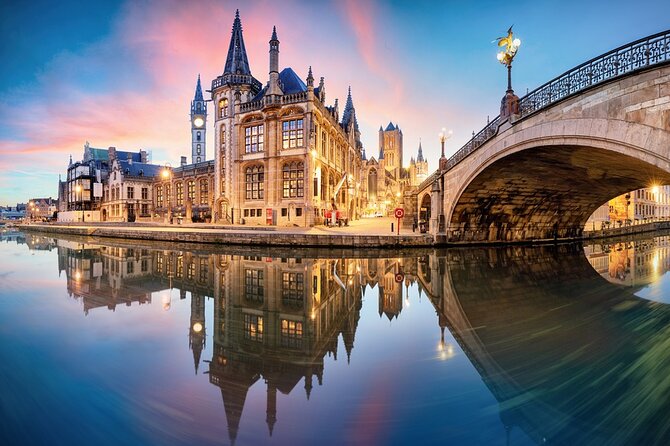
The first stop, St Michael’s Bridge, is an excellent place to begin. You get an introduction to Ghent’s role as a medieval trading center and a clear view of the city’s famous three towers.
This opening gives you a useful map in your head. Instead of seeing the old center as a collection of pretty buildings, you begin to understand how churches, civic power, commerce, and defense shaped the skyline.
The stop lasts about 15 minutes, making it the longest scheduled pause. Admission is free because the tour stays outside. Bring a moment of patience here, since the guide is laying the groundwork for the rest of the walk.
St Bavo’s Cathedral and the Devil’s Tower
At St Bavo’s Cathedral, the tone turns darker. Your guide explains the grim story behind the nickname Devil’s Tower, adding an unsettling layer to a building that might otherwise seem simply grand and religious.
You do not enter the cathedral. That is important if you want to see the interior or visit its art and treasures. This stop is about the story connected to the exterior and the role of religion in Ghent’s past.
The scheduled time is about 10 minutes. That is enough for a focused tale, but not for a full architectural visit. I would treat this as a preview, not a substitute for a separate cathedral visit.
Graslei and Korenlei, where money shaped the city
Graslei and Korenlei mark the old medieval harbor. Here, the guide explains the trading activity that helped make Ghent an economic force in Europe.
This section gives the tour needed balance. The dark side of a city is not only punishment and death. It also includes wealth, ambition, and the systems that made powerful merchants and rulers possible.
The harbor area is one of Ghent’s most recognizable settings, yet a guide can help you see beyond the attractive waterfront. Listen for how commerce affected the city’s buildings, status, and growth.
You spend about 10 minutes here, outside and without an admission fee. The short stop works well on a walking tour, though anyone hoping for a long discussion of medieval trade may want to ask follow-up questions.
A few more Ghent trips to weigh up
- Ghent: Private 2-Hour Walking Tour
★ 4.7 · 134 reviews - Private Historical Tour: The Best of Ghent
★ 5.0 · 115 reviews - Private Highlights Walking Tour in Ghent
★ 5.0 · 71 reviews - Charlie’s Private Chocolate Tour (Ghent)
★ 5.0 · 34 reviews
Appelbrugparkje and a story of execution
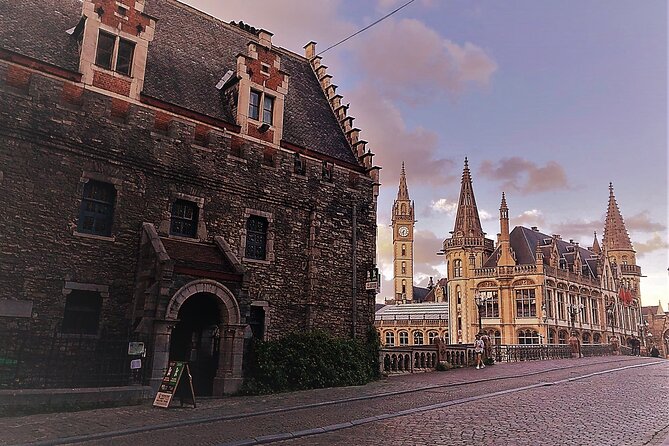
At Appelbrugparkje, the tour reaches one of its clearest macabre moments. From a bridge overlooking the large Butchers’ Hall, you hear the legend of a father and son condemned to execution and the miraculous event said to have saved them.
This is exactly the kind of compact local tale that can make a city feel specific. It is not a broad lecture about Belgium. It is one place, one view, and one story attached to it.
The stop lasts around 10 minutes and is free. The story is likely to work best if you enjoy legends presented alongside real streets and buildings. If you prefer only firmly documented history, ask your guide to explain where legend ends and historical record begins.
Gravensteen, Ghent’s fortress
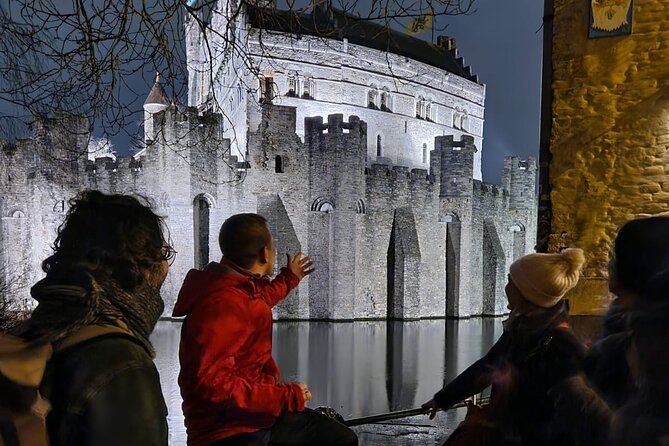
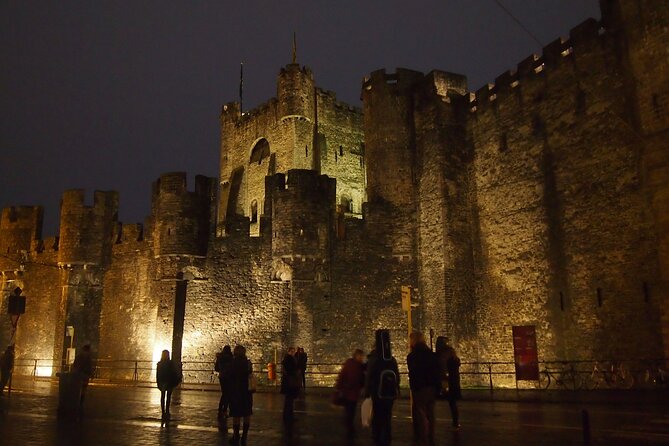
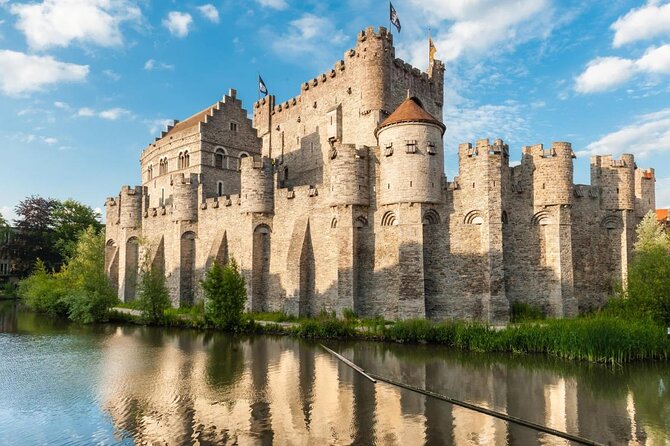
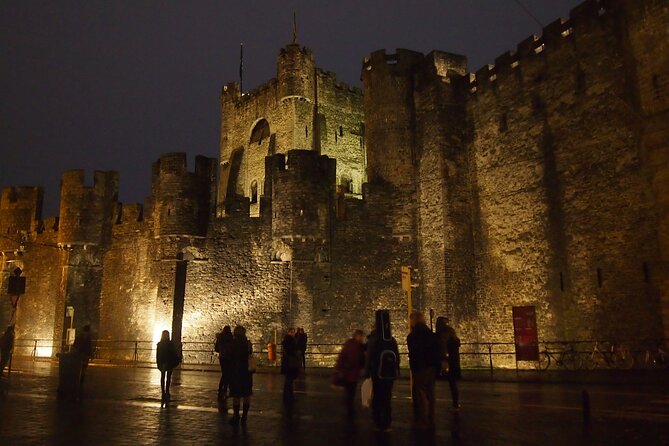
Gravensteen is the visual centerpiece of the route. The fortification was built by Count Baldwin in the ninth century to protect inhabitants from Viking raids, and the guide explains how the city began developing around it.
Even from outside, the castle gives the tour a strong sense of place. Its defensive purpose helps explain why Ghent grew where it did and why power in the city was tied to walls, rulers, and control.
The stop is about 10 minutes, with admission not included. You should not expect to tour the rooms or exhibits as part of this activity. If Gravensteen is high on your list, plan a separate visit at a time when you can explore inside.
Still, the outside explanation adds value. A castle is easy to photograph and just as easy to misunderstand. The guide connects the stone structure to raids, protection, and the early growth of Ghent.
Prinsenhof and the remains of royal power
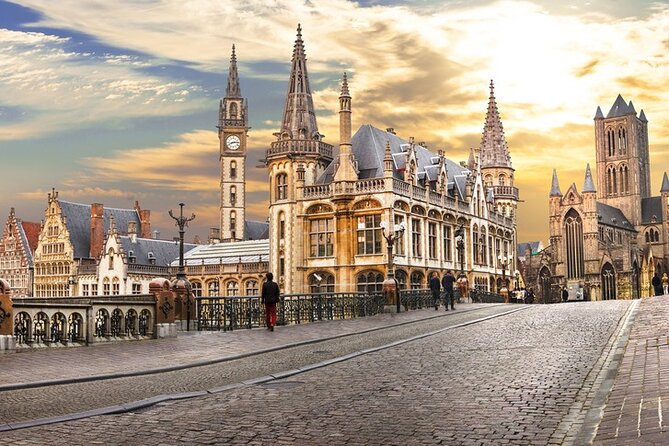
Prinsenhof once formed a huge palace complex known as the Prince’s Court. Today, the setting requires imagination, and that is where the guide’s storytelling matters most.
This stop is less about a single dramatic structure and more about what has disappeared. You are asked to picture the scale and importance of a palace that no longer dominates the area in the same way.
The tour does not include entry. It gives you roughly 10 minutes of explanation from outside. I like this kind of stop because it moves beyond the city’s most polished monuments, but it may feel less satisfying if you want visible ruins or a preserved interior.
Rabot Sluice and the old defense wall
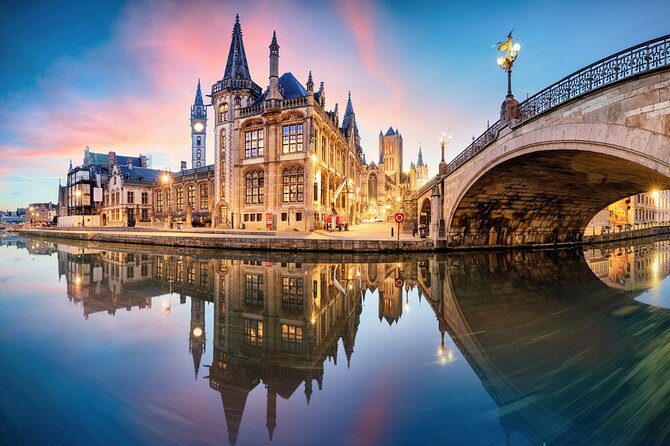
Rabot Sluice provides a change of mood and setting. Your guide points out the only remaining tower from a 14-kilometer defense wall built around Ghent in the Middle Ages.
That detail gives you a sense of scale. The city was not protected by one castle alone. It had a wider defensive system, much of which has vanished.
The stop is free and lasts about 10 minutes. It is one of the route’s more unusual points because many short city walks stay close to the central postcard views. Here, you get a better feel for the city’s former edge and military planning.
Keizer Karel and the Bridge of Imperial Delights
At Keizer Karel, the route focuses on Charles V and the bridge called the Bridge of Imperial Delights. Four sculptures show legendary scenes from the emperor’s life, and the guide explains some of them.
This stop adds a personal and political angle to the tour. Instead of looking only at anonymous medieval institutions, you meet a ruler whose life became part of Ghent’s public art and local memory.
Again, the scheduled time is about 10 minutes. The sculptures give you something concrete to study while the guide supplies the context. I would pay close attention here, since small monuments can be easy to pass without understanding what they represent.
Augustijnenklooster and religious conflict
The Augustinian monastery introduces one of the most important themes in Ghent’s later history: the Religious Wars and the effect of Calvinist rule on the city.
This is where the tour moves from medieval defense and trade into belief, authority, and social conflict. Religious change was not a quiet matter. It affected buildings, leadership, public life, and the way communities understood power.
The monastery is viewed from outside, and admission is not included. With only about 10 minutes here, the guide cannot offer a full course in the Religious Wars. Still, this stop helps explain why Ghent’s past cannot be reduced to old merchants and castles.
Patershol, the right place to finish
The last stop is Patershol, a picturesque medieval quarter whose name means Monk’s hole. The guide connects this neighborhood to the social effects of the Industrial Revolution and the revival of Ghent’s economy.
That ending is smart. The walk begins with medieval trade and power, then finishes by showing how the city changed much later. You leave with a longer view of Ghent, from fortified settlement to industrial center and renewed historic quarter.
The tour ends in central Patershol, close to many bars and restaurants. This makes it easy to turn the walk into an evening plan. You can ask your guide for food suggestions, as several guides are praised for offering useful local advice.
How much value do you get for $105.59?
At $105.59 per person, this is not a cheap orientation walk. The value depends heavily on your group size and how much you use the private format.
For a larger group, a private guide can compare well with several separate tickets or a more rigid group tour. You get nearly two hours of personal attention, an English-speaking guide, and a route that combines major sights with quieter locations.
For two people, the cost feels more demanding. You are paying for exclusivity and conversation rather than entry to Gravensteen, St Bavo’s Cathedral, Prinsenhof, or the Augustinian monastery. Group discounts are available, but the exact savings are not stated, so check the total before booking.
The strongest value comes if you enjoy stories and questions. Guides such as Kenny, Debra, Isabelle, Jerke, Hamraz, and Sébastien have been singled out for humor, warmth, passion, patience, and strong local knowledge. That human element can make the price worthwhile.
The stated rating is 4.9 from 73 reviews, with 99 percent recommending the experience. One sharply negative assessment found the tour too flat and expensive, which is a fair warning: the word dark does not guarantee horror, theatrical scares, or nonstop gruesome material.
Who will enjoy this walk most?
I would choose this tour for a first or second evening in Ghent, especially if you want a city introduction with more character than a standard monument checklist. Several people have used it as their first activity, and that makes sense because the route gives you a useful spread of neighborhoods and landmarks.
It also suits:
- Couples who enjoy legends and old crimes
- Families whose children can manage a 1 hour 45 minute walk
- History fans who like political and religious context
- Visitors who prefer a private conversation to a large group
- Anyone who wants restaurant options at the end
You may want something else if you need extensive interior visits, a strictly factual lecture, or a theatrical ghost show. This tour stays outdoors, moves quickly between 10-minute stops, and mixes documented history with local legend.
Most people can participate, the route is near public transportation, and service animals are allowed. The meeting point is Hostel Uppelink at Sint-Michielsplein 21. The tour is offered in English.
Free cancellation is available until 24 hours before the start time. After that point, the payment is not refunded, and late changes are not accepted.
FAQ
How long is The Dark Side of Gent tour?
The tour lasts approximately 1 hour and 45 minutes.
Where does the tour start?
It starts at Hostel Uppelink, Sint-Michielsplein 21, 9000 Gent, Belgium.
Where does the tour end?
It ends in Patershol in central Ghent, close to bars and restaurants.
Is this a private tour?
Yes. Only your group takes part in the activity.
Is the tour offered in English?
Yes. English is the listed language.
Are entrance tickets included?
No. Entry to St Bavo’s Cathedral, Prinsenhof, the Augustinian monastery, and Gravensteen is not included. Several other stops are viewed from public areas and have no admission fee.
Can I cancel for a full refund?
Yes, if you cancel at least 24 hours before the experience start time. Cancellations made less than 24 hours before the start time are not refunded.
Should you book it?
Book this walk if you want Ghent explained through dark legends, old power struggles, religious conflict, and the lives behind its grand streets. The private format and strong guide-led style are the main reasons to pay the premium.
I would schedule it early in your stay, not on your final night. You will finish in Patershol with time for dinner, and the route will help you make sense of the city when you explore on your own.
Skip it if you want a low-cost tour, lots of interior access, or a full horror performance. For the right audience, though, this is a lively way to see Ghent at night and learn why its beautiful center has so many unsettling stories beneath the surface.
Just added around Ghent
- Walking Food Tour in Ghent★ 5.0 · 13 reviews
- Historic Highlights, by a local guide★ 5.0 · 9 reviews
- Discover Ghent while playing! Escape game – The Walter case★ 4.5 · 4 reviews
- Discover Mons while playing! Escape game – The alchemist★ 4.0 · 5 reviews
- Ghent Walking Tour with Audioguide on Your Smartphone★ 4.5 · 13 reviews
- Discover Ghent with a self-guided Outside Escape city game tour!★ 4.0 · 10 reviews
- e-Scavenger hunt Ostend: Explore the city at your own pace★ 4.5 · 10 reviews
- e-Scavenger hunt Kortrijk: Explore the city at your own pace★ 4.5 · 15 reviews
Dark Side Tours, compared.

Browse the lists this tour appears in