
Reviewed · FLANDERS FIELDS WWI TOURS
From LIlle or Bruges, Christmas Truce to Passchendaele Ypres 1 day WW1 private
The most striking part of this day is its sweep. In about nine hours, you follow the old Australian advance from the Christmas Truce site at Messines through Hill 60 and Polygon Wood to Passchendaele, then finish among the names at the Menin Gate. This is not a quick stop at one memorial. It is a full day of ground, stories, cemeteries, and surviving trenches.
I like the private format, which lets you ask questions without holding back a larger group. I also like the chance to tailor the day to family history, especially if an ancestor served in the Australian forces. Guide Soren brings strong subject knowledge, a thoughtful manner, and a gentle sense of humour to difficult material.
The main consideration is the pace. You cover many sites, and several stops are brief. At $532.32 per person, the price makes the most sense for a private group that values door-to-door transport and personal guidance. Lunch is not included, so you need to plan for that during a long day.
In This Review
- Key points to know before booking
- Why this private tour works well
- Messines Ridge and the Christmas Truce
- Hooge Crater Cemetery and the Menin Road
- Polygon Wood and Australia’s 5th Division
- Hill 60 and the mine at 3:10 a.m.
- Following the Australian advance to Zonnebeke
- Tyne Cot Cemetery and the scale of loss
- John McCrae’s site and In Flanders Fields
- Menin Gate and 55,000 missing names
- Sanctuary Wood’s original trenches
- Price, pickup, and the long day
- Who should book this Ypres tour?
- Should you book A Foreign Field WW1 Tours?
- FAQ
- How long is the Ypres battlefield tour?
- Where can pickup be arranged?
- Is this a private tour?
- Is the tour offered in English?
- What sites are included?
- Is lunch included?
- Can the tour be tailored to family history?
- Are admission fees included?
- What is the cancellation policy?
Key points to know before booking
- A private route through the Ypres Salient: Your group alone takes the tour, with pickup available from hotels and B&Bs within a 66-kilometre radius of Ypres.
- The Christmas Truce and Hitler’s wartime treatment: Messines combines mine craters, battlefield stories, and the crypt where Adolf Hitler was treated for wounds.
- Strong Australian focus: Polygon Wood, the Menin Road, Hill 60, and the line toward Zonnebeke connect directly with Australian actions.
- Two major memorial experiences: Tyne Cot brings you to the Commonwealth War Graves Commission’s largest cemetery, while the Menin Gate carries 55,000 names of the missing.
- Original trenches at Sanctuary Wood: This is one of the few places on the route where you can see First World War trench remains in a museum setting.
- A practical pickup plan: The tour begins at 9:00 a.m., with pickup from Lille, Arras, Ghent Dampoort Station, Bruges, and other locations in range.
Why this private tour works well
The Ypres Salient can feel scattered on a map. One cemetery lies beyond a village, a memorial sits beside a modern road, and a battlefield feature may be hidden in ordinary farmland. A private guide saves you from treating each place as an isolated stop.
Soren’s role matters here. The strongest praise for this experience centers on his ability to explain battles clearly, answer questions, and adjust the day to your interests. That is useful because the route contains much more than names and dates. You will hear how trenches, mines, roads, woods, headquarters, and artillery positions shaped the fighting.
I would especially consider this tour if you have a family connection to the region. Give the guide names, units, dates, or likely battle areas before the day if you have them. The tour can then place your family story alongside the wider actions, rather than leaving you with a cemetery visit and no sense of context.
The private setup also helps if your group includes both serious First World War students and people who know less about the conflict. You can pause for explanation, ask about a particular regiment, or move on when a subject has been covered sufficiently. A standard group tour rarely gives you that freedom.
More Flanders Fields WWI Tours in Ypres
- In Flanders Fields and Passchendaele Half Day Morning Tour
★ 5.0 · 117 reviews - From Brussels: Flanders Fields Remembrance Full-Day Trip
★ 4.4 · 65 reviews - From Ypres, The Christmas Truce to Passchendaele Ypres Based WW1 private tour
★ 5.0 · 29 reviews
Messines Ridge and the Christmas Truce
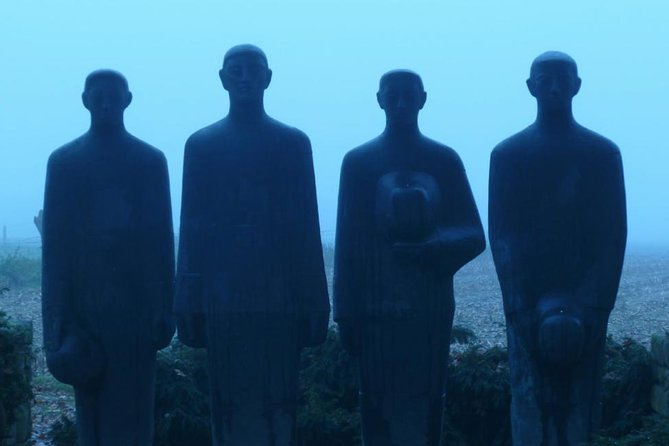
Messines is the longest stop, with about two hours set aside for the ridge, mine craters, and several connected stories. That extra time is welcome. The Battle of Messines is easier to understand when you can link the ground, the mine explosions, and the wider push toward Passchendaele.
You will also visit the scene associated with the Christmas Truce. This adds a human scale to a war often reduced to artillery, mud, and casualty figures. The truce story is not a reason to soften the reality of the fighting, but it gives you a glimpse of the men on opposite sides who briefly recognized one another as people.
Another unusual part of this stop is the crypt where Adolf Hitler was treated for his wounds. It is a stark reminder that the First World War involved figures who later shaped Europe in very different ways. The site is historically important, but its value comes from the guide’s explanation and the surrounding battlefield context, not from a grand display.
The mine craters are the physical feature to watch for. They help you grasp the force used beneath the lines, though you should not expect a polished museum attraction at every point. Much of this tour takes place outdoors at real sites, where the interest comes from location and explanation.
Hooge Crater Cemetery and the Menin Road
The visit to Hooge Crater Cemetery lasts about 15 minutes, so treat it as a focused stop. You will visit the grave of Pat Bugden VC, a 20-year-old Victoria Cross recipient, and hear about the action connected with him.
You will also be on the Menin Road, beside the area where Australian gun pits supported the assault on Passchendaele. This is a useful place to understand how a road could become a military artery. It carried troops, supplies, guns, and wounded men, while also drawing enemy fire.
The short timing is the trade-off. You will not have a long period for quiet reflection or a detailed search through every row. If a particular grave matters to you, tell Soren early so the stop can be handled with care.
The route then passes a site that served as Australian headquarters in September 1917. You will also hear about earlier fighting on the same ground in November 1914. That layering is one of the day’s strengths. The same fields changed hands, purpose, and meaning as the war continued.
Polygon Wood and Australia’s 5th Division
At Polygon Wood, you walk through the woods and see concrete bunkers that remained from the fighting. The stop lasts about 30 minutes, enough for a short walk, a cemetery visit, and time at the Australian 5th Division monument.
This is one of the better stops for connecting a unit with a place. Instead of hearing only that a division fought somewhere near Ypres, you see the ground where the action took place and the structures built for survival. The bunkers also show how much of the battlefield was reinforced with concrete, rather than relying only on shallow earth trenches.
The woods are not a stage set. Their modern appearance can make the past feel distant. That is where Soren’s explanation earns its keep. He can point out how the position fitted into the Australian advance and why the area mattered during the battle.
You should expect walking on uneven outdoor ground at several points during the day. The tour is described as suitable for most participants, but comfortable shoes remain a sensible choice. The schedule has many stops, so wear something practical rather than treating this as a city sightseeing day.
Same old town, a completely different kind of day:
- From IEPER Private 4-hour Tour of the Ypres Battlefield
★ 5.0 · 154 reviews - Ypres: An exploration of the deadly salient battlefields
★ 5.0 · 76 reviews - In Flanders Fields and Passchendaele Grand Tour
★ 5.0 · 25 reviews - From Ypres: WWI Battlefields Private Tour
★ 5.0 · 25 reviews
Hill 60 and the mine at 3:10 a.m.
Hill 60 gets about 45 minutes and carries one of the tour’s most memorable engineering stories. You will hear about Captain Woodward and the 1st Australian Tunnelling Company, who placed a massive mine beneath the position. It exploded at 3:10 a.m. on June 7, 1917, creating the crater you will see.
A crater gives the story physical shape. You are not simply told that mines were used. You can look at the ground and consider the labour, risk, secrecy, and timing involved in putting explosives beneath an enemy position.
This stop also helps explain why the First World War was fought above and below ground. Soldiers faced rifle fire and shelling at the surface, while tunnellers worked in darkness with the danger of collapse and discovery. The human effort behind a single explosion was immense.
Hill 60 is best for people who like military detail, but it also works for anyone who wants to understand how technology changed the battlefield. Soren’s storytelling links the individuals to the operation, so the mine does not become just another crater on a route full of them.
Following the Australian advance to Zonnebeke
Between major stops, the vehicle follows the line of the Australian advance. This driving time is not filler. It lets you see how the separate places connect and gives the guide room to explain movements that are difficult to grasp from a single memorial.
The route through Zonnebeke continues that Australian focus. You will pass through the area along the advance and hear how the fighting moved across the region. Modern roads and buildings can obscure the wartime view, but the movement between sites gives you a stronger sense of distance than a series of disconnected photographs ever could.
This is also where a private tour has a practical edge. If you are trying to follow a relative’s unit, you can ask questions while driving between locations. The day becomes a connected field study rather than eight unrelated photo stops.
Tyne Cot Cemetery and the scale of loss
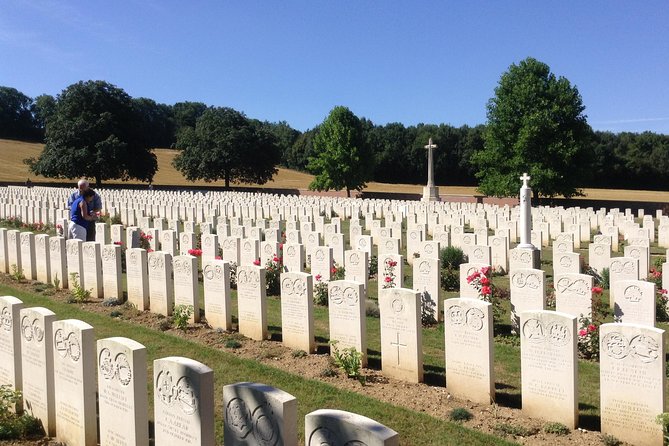
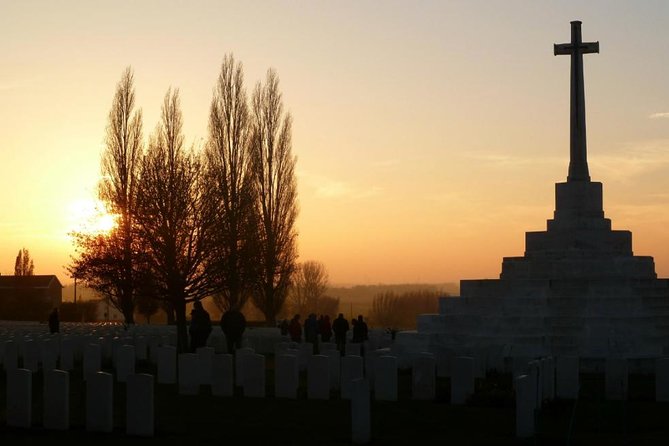
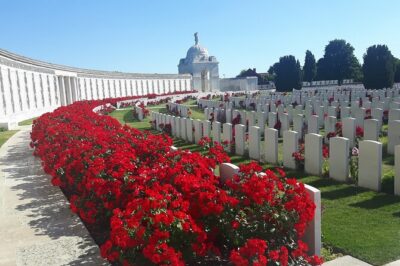
Tyne Cot is the largest Commonwealth War Graves Commission cemetery in the world, with about 12,000 soldiers buried there according to the tour information. Only around 3,000 of those graves have names. Two Australian Victoria Cross recipients are also buried at the cemetery.
The scale can be difficult to take in. A cemetery of this size changes your sense of the war from individual stories to mass loss, yet each grave still represents one person. The contrast between named and unidentified dead is especially powerful.
You have about 45 minutes here. That is enough to walk through part of the cemetery and listen to the explanation, though you may want longer if you are researching a particular grave. The schedule does not promise unlimited time, so tell the guide if Tyne Cot is your main reason for booking.
I find cemeteries like this most useful when paired with battlefield ground. Earlier stops show how the fighting worked. Tyne Cot shows its human cost. The order of the day makes that connection clear without needing a museum lecture.
John McCrae’s site and In Flanders Fields
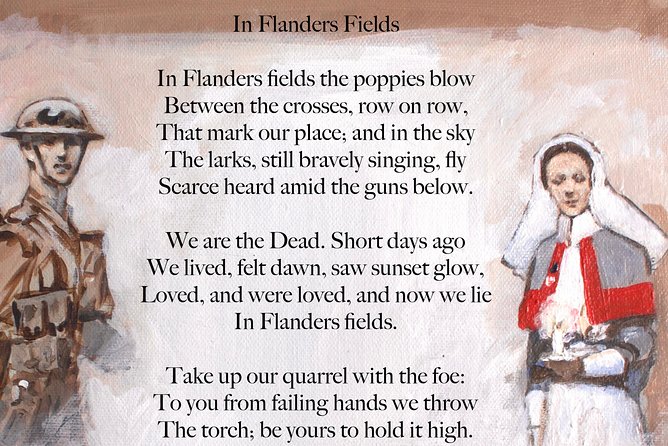
The John McCrae stop lasts about 30 minutes and takes you to the hospital site where Lieutenant Colonel John McCrae composed In Flanders Fields. The poem is familiar to many people, but standing at the place tied to its creation gives the words a more direct setting.
This is a quieter part of the day. You will hear about McCrae and the hospital work around him, then consider how a poem became one of the best-known expressions of remembrance from the First World War.
Do not expect a large attraction with extensive indoor displays based on the information provided. The value is the location, the poem, and the guide’s explanation. If you know the poem well, this stop may feel more reflective than informational. If you do not, it gives useful context before the final memorial visit.
Menin Gate and 55,000 missing names
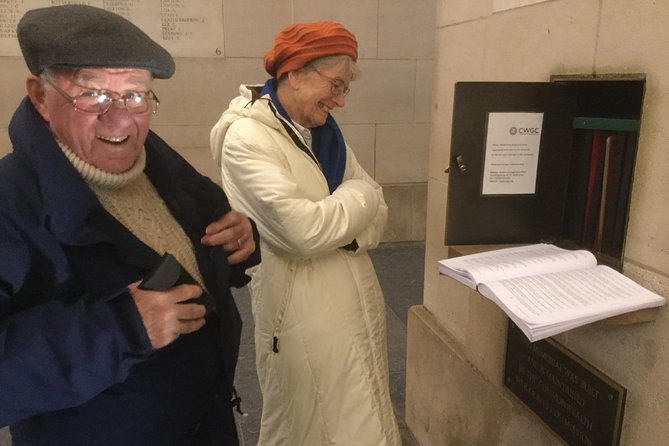
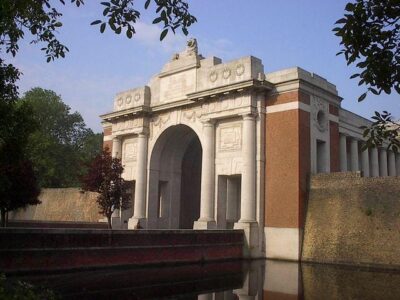
The Menin Gate is one of Ypres’s defining memorials. You will hear how it came about and learn about the 55,000 names listed there for soldiers who went missing and have no known grave.
The number is almost too large to picture. The memorial solves that problem in a simple way: it gives the missing a place in the city they fought to defend. You can walk beneath the structure and see how remembrance was built into the daily life of Ypres.
The planned stop lasts about 20 minutes. That works for an introduction and a walk through the memorial, but it may feel short if you want to study many names. If your family member is listed there, provide the details in advance and tell Soren as soon as the day begins.
The Last Post ceremony may be possible depending on timing, but it is not listed as a guaranteed part of the tour. If hearing it matters to you, ask about the schedule before booking rather than assuming the nine-hour route will finish at the right time.
Sanctuary Wood’s original trenches
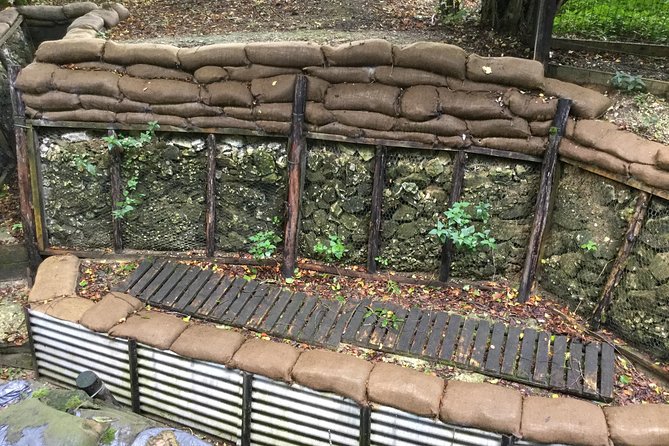
Sanctuary Wood Museum closes the day with about 40 minutes among original First World War trenches. This is the only stop specifically described as including museum admission, while the other listed sites have no admission charge.
The trenches are useful because they show the cramped shape of frontline life. Memorials can tell you who died and where units fought. Original trench remains help you picture the physical conditions, though you should not expect them to recreate every aspect of daily service.
Ending here gives the tour a different texture from the grand memorials at Tyne Cot and the Menin Gate. You finish with the defensive ground itself, not only with names carved in stone. It is a fitting final stop after hearing about advances, mines, headquarters, and artillery positions.
The museum portion also provides a change after a day spent largely outside. Still, the stop is only 40 minutes, so you will need to keep an eye on time if you want to examine everything carefully.
Price, pickup, and the long day
The price is $532.32 per person. That is a serious cost, but the value depends on your group size and priorities. You are paying for a private nine-hour day, a guide focused only on your party, hotel or B&B pickup, and transport across a wide area of the Ypres Salient.
Pickup is offered within a 66-kilometre radius of Ypres. Listed options include Lille in France, Arras in France, Bruges, and Ghent Dampoort Station for Ghent pickups. This can save you the trouble of arranging a train, rental car, or separate local transport.
For one or two people, the cost may feel high. For a small private group splitting the price, the value improves. It is also stronger if you have a family connection or a serious interest in First World War history, since the guide can shape the day around your questions.
Bottled water is included. Lunch is not, so plan for that during the nine-hour schedule. The supplied details do not specify a lunch stop, so ask how the day handles the midday meal if you prefer a proper break rather than a quick snack.
The tour is offered in English and begins at 9:00 a.m. Confirmation is sent within 48 hours of booking, subject to availability. Free cancellation is available if you cancel at least 24 hours before the start time. Later cancellations and changes are not accepted for a refund.
Who should book this Ypres tour?
I would recommend it most strongly to:
- People with Australian First World War family history
- Anyone who wants a private guide rather than a fixed group schedule
- Visitors staying in Bruges, Lille, Ghent, Arras, or nearby towns
- First World War enthusiasts who want mine craters, bunkers, cemeteries, and trenches in one day
- Couples or small groups willing to pay more for personal attention
- People who prefer a serious historical day over a light sightseeing outing
I would be more cautious if you want long, unhurried visits at every cemetery. The route covers a lot of ground, and Hooge Crater Cemetery and the Menin Gate receive only about 15 and 20 minutes respectively. You should also reconsider if your group dislikes outdoor walking, battlefield discussion, or a schedule with many stops.
The tour is suitable for most participants, and service animals are allowed. It is also near public transportation, although the main convenience is the offered pickup rather than a need to navigate between sites yourself.
Should you book A Foreign Field WW1 Tours?
Book this tour if you want the full Ypres Salient story, not just a single cemetery. The route links the Christmas Truce, Messines mines, Australian actions, Passchendaele, Tyne Cot, John McCrae, the Menin Gate, and original trenches in one carefully focused day.
The strongest reason to choose it is Soren. His clear explanations, personal attention, and willingness to answer questions suit a subject that can quickly become confusing. Ask for him if possible, and send family details ahead of time if you have them.
The price is easier to justify when shared by a private group or when the pickup saves you a separate day of transport planning. If those points fit your trip, this is a moving and useful way to understand the fields around Ypres.
FAQ
How long is the Ypres battlefield tour?
The experience lasts about nine hours and begins at 9:00 a.m.
Where can pickup be arranged?
Pickup is offered from hotels or B&Bs within a 66-kilometre radius of Ypres. Listed pickup areas include Lille, Arras, Bruges, and Ghent Dampoort Station for Ghent.
Is this a private tour?
Yes. Only your group participates in the activity.
Is the tour offered in English?
Yes, the tour is offered in English.
What sites are included?
The route includes Messines Ridge, Hooge Crater Cemetery, the former Australian headquarters area, Polygon Wood, Hill 60, Tyne Cot Cemetery, the John McCrae site, the Menin Gate Memorial, Zonnebeke, and Sanctuary Wood Museum.
Is lunch included?
No. Bottled water is included, but lunch is not.
Can the tour be tailored to family history?
Yes. The tour can be tailored if you have family history connected with the region.
Are admission fees included?
Admission is listed as free at the main battlefield, cemetery, memorial, and historical sites. Sanctuary Wood Museum includes admission as part of the tour.
What is the cancellation policy?
You can cancel up to 24 hours before the experience start time for a full refund. Cancellations or changes made less than 24 hours before the start time are not accepted for a refund.
More Christmas in Ypres
More 1-Day Tours in Ypres
- From Brussels: Guided Day Trip to Bruges and Ghent
★ 4.6 · 8,353 reviews - From Amsterdam: Bruges Day Trip in English with Boat Option
★ 4.4 · 1,989 reviews - From Amsterdam: Bruges Day Trip in Spanish with Boat Option
★ 4.6 · 1,866 reviews - Luxembourg and Dinant Day Trip from Brussels
★ 4.0 · 1,474 reviews
Just added around Ypres
- In Flanders Fields and Passchendaele Grand Tour★ 5.0 · 25 reviews
- e-Scavenger hunt Ypres: Explore the city at your own pace★ 4.5 · 6 reviews
- PRIVATE Australian Western Front Battlefields 3-Day Tour Ypres to Amiens★ 5.0 · 3 reviews
- Discover Tournai while playing! Escape game – The alchemist★ 4.0 · 3 reviews
- From Ypres 4hr Christmas Truce and Monster Mines of Messines PRIVATE Tour★ 5.0 · 5 reviews
- Full Day Canadian WW1 Vimy and Somme Battlefield Tour from Ypres★ 5.0 · 6 reviews
- From Ypres, The Christmas Truce to Passchendaele Ypres Based WW1 private tour★ 5.0 · 29 reviews
- From Ypres: WWI Battlefields Private Tour★ 5.0 · 25 reviews
Flanders Fields WWI Tours, compared.
Great War Flanders Fields Minibus Tour w/ Lunch
Read our review →
Flanders Fields Remembrance Tour from Brussels
Read our review →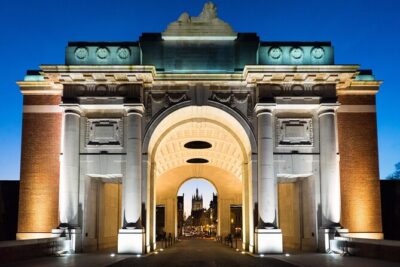
In Flanders Fields and Passchendaele Half Day Morning Tour
Read our review →
From Ypres, The Christmas Truce to Passchendaele Ypres Based WW1 private tour
Read our review →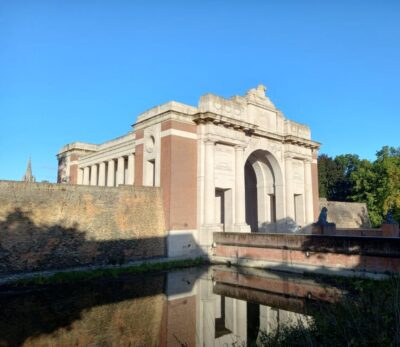
Browse the lists this tour appears in