
Reviewed · FLANDERS FIELDS WWI TOURS
From Ypres, The Christmas Truce to Passchendaele Ypres Based WW1 private tour
The most moving part of this Ypres tour is how it links famous sites with small, human stories. You follow the ground of the Christmas Truce, see the crater made by a huge 1917 mine at Hill 60, and finish among the names at the Menin Gate. I especially like that guide Soren can connect the battlefield to your own family research, rather than giving you a standard speech.
I also like the private format and the way the day moves across the Ypres Salient. You get water, hotel pickup from selected Ieper hotels, and a route that covers far more ground than you could sensibly manage on foot. The main consideration is the price: at $420.49 per person, with a minimum of two people, this is a serious outlay. It makes better value for families or small groups with a strong interest in the First World War.
In This Review
- Key points to know before booking
- Why this Ypres battlefield tour works
- Messines Ridge and the Christmas Truce
- Hooge Crater Cemetery and the Menin Road
- The Black Watch and Polygon Wood
- Hill 60 and the mine blown at 3:10 am
- Broodseinde and Zonnebeke: following the Australian advance
- Tyne Cot Cemetery and 12,000 Commonwealth burials
- John McCrae’s hospital site and the making of a poem
- The Menin Gate and 55,000 missing names
- Sanctuary Wood’s original trenches and small museum
- Price, pickup, and the real value of a private day
- Who should book this tour
- Should you book the Ypres Christmas Truce and Passchendaele tour?
- FAQ
- Where does the tour begin?
- How long does the tour last?
- How many people are required to book?
- Is the tour private?
- What language is the tour offered in?
- Is lunch included?
- What is included in the tour?
- Can I start the tour in Lille, Arras, or Bruges?
Key points to know before booking
- The Christmas Truce is part of a wider battlefield story: Messines Ridge includes the truce site, mine craters, and the location where Adolf Hitler was treated for wounds.
- Soren shapes the day around your interests: The private tour can focus on Australian units, family graves, South African connections, or the general military story.
- You cover the main Ypres Salient by vehicle: The route includes Messines, Hill 60, Polygon Wood, Broodseinde, Zonnebeke, Tyne Cot, and central Ypres.
- Original trenches add a rough physical sense of war: Sanctuary Wood Museum includes surviving First World War trenches and a small museum.
- Cemeteries are central, not incidental: Hooge Crater Cemetery, Tyne Cot, and the Menin Gate give the battles a personal scale.
- Plan for a full day: The tour lasts about eight hours, begins at 9:00 am, and does not include lunch.
Why this Ypres battlefield tour works
Ypres is easy to underestimate. Today, the town and nearby villages look peaceful, and much of the wartime ground has been rebuilt or returned to farmland. Without help, it can be hard to understand where the front ran, why a ridge mattered, or how one cemetery relates to a battle several miles away.
That is where this private tour earns its keep. Soren has lived in the Ypres area for 15 years and brings a personal connection to the subject. His great-uncle died in the war, and that family link helps explain the care he brings to individual stories.
You are not simply driven from one memorial to the next. The route follows Australian advances and positions, while also giving room for earlier actions in 1914, the Christmas Truce, tunnelling warfare, and the medical story behind John McCrae’s poem In Flanders Fields.
The private setup matters. You are with your own party, not a large coach group, and the day can be adjusted to your knowledge and family interests. One couple used the tour to find South African graves and received extra links afterward to books, films, and podcasts. Another had Soren trace a great-grandfather’s movements from landing to death.
That level of attention will not matter equally to everyone. If you only want a quick introduction to Ypres, eight hours may feel long. If you want context, family research, and time to ask questions, the length is one of the tour’s strengths.
More Flanders Fields WWI Tours in Ypres
- In Flanders Fields and Passchendaele Half Day Morning Tour
★ 5.0 · 117 reviews - From Brussels: Flanders Fields Remembrance Full-Day Trip
★ 4.4 · 65 reviews - In Flanders Fields and Passchendaele Grand Tour
★ 5.0 · 25 reviews
Messines Ridge and the Christmas Truce
The first major stop is Messines Ridge, where you spend about two hours. This is the longest stop, and rightly so. The area brings together several different strands of the war.
You hear about the Battle of Messines and visit mine craters connected with the British underground campaign. The great mine explosion of June 1917 is one of the defining stories of this part of Belgium, but Messines also carries an earlier and more unusual memory: the Christmas Truce.
The truce is often reduced to a sentimental tale of soldiers playing football. The reality was less tidy, varied from place to place, and happened amid an ongoing war. A good guide can help you hold both truths at once. Here, Soren places the truce in the setting of the front, where soldiers on opposing sides were close enough to hear and see one another.
You also visit the crypt where Adolf Hitler was treated for wounds. That is a striking detail, but it should not overshadow the larger story of the soldiers who fought and died here. The value is in seeing how one location gathered many layers of wartime history.
Messines takes two hours, so expect a slower start rather than a rapid checklist. Wear shoes suitable for uneven outdoor ground and allow your attention to shift between military engineering, battlefield geography, and personal stories.
Hooge Crater Cemetery and the Menin Road
The stop at Hooge Crater Cemetery lasts about 15 minutes. That sounds brief, but cemetery visits can be emotionally heavy, and the stop fits into a day already packed with sites.
Here you visit the grave of Pat Bugden VC, an Australian soldier who received the Victoria Cross at age 20. The focus on one young man gives the broader battle a human face. You also stand on the Menin Road, alongside the area where Australian gun pits supported the assault on Passchendaele.
This is a useful place to ask questions about how troops, artillery, roads, and supply lines fitted together. The Menin Road was not just a name on a map. It was a key route through a dangerous area, and the position helps you picture the movement of Australian forces.
Because the stop is short, tell Soren in advance if a particular grave or unit matters to you. The tour is customizable, but specific family research works best when the guide has time to prepare.
The Black Watch and Polygon Wood
The Black Watch site adds a different layer to the route. It marks the place of an Australian headquarters in September 1917, while also taking you back to actions fought on the same ground in November 1914.
That overlap is useful. The Ypres Salient was fought over repeatedly, and the same village, road, or wood could matter in several campaigns. You begin to see that the war here was not one single battle but a series of offensives, defensive positions, withdrawals, and returns.
At Polygon Wood, you spend about 30 minutes walking through the woods and visiting concrete bunkers left from the period when Australian soldiers captured the area. You also visit a cemetery and the Australian 5th Division monument.
This is one of the better stops for understanding how the ground itself shaped the fighting. Woods offered cover but also limited visibility. Bunkers show the effort made to survive artillery fire. Monuments and graves then bring the scale back to individual units.
The walk is not described as strenuous, but this is still an outdoor stop. The condition of paths can affect how comfortable the visit feels, so practical shoes are a sensible choice.
Same old town, a completely different kind of day:
- From IEPER Private 4-hour Tour of the Ypres Battlefield
★ 5.0 · 154 reviews - Ypres: An exploration of the deadly salient battlefields
★ 5.0 · 76 reviews - From Ypres: WWI Battlefields Private Tour
★ 5.0 · 25 reviews - e-Scavenger hunt Ypres: Explore the city at your own pace
★ 4.5 · 6 reviews
Hill 60 and the mine blown at 3:10 am
Hill 60 is one of the tour’s most memorable technical and physical stops. You spend about 45 minutes hearing the story of Captain Woodward and the 1st Australian Tunnelling Company, who placed a massive mine beneath the position.
The mine was blown at 3:10 am on June 7, 1917. You see the crater created by that explosion, an unusually direct link between an engineering operation and the ground it changed.
For me, this is where the tour’s use of local knowledge matters most. A crater can look like a simple hollow until you understand the months of tunnelling, the danger of collapse, and the planning needed to place explosives under enemy positions. Soren’s explanation gives the feature scale and purpose.
It is also a good reminder that the First World War was fought below ground as well as above it. Soldiers faced artillery, rifles, mud, and barbed wire, but tunnelling units fought a quieter and highly dangerous battle beneath the front.
Broodseinde and Zonnebeke: following the Australian advance
Broodseinde and Zonnebeke are mainly driving stops. You pass through the line of the Australian advance, linking the places you have already visited with the broader Passchendaele story.
These sections may feel less dramatic because you are not necessarily getting out at every location. Their value is geographical. After seeing cemeteries, bunkers, craters, and woods, you can understand how the route fits together instead of treating each site as an isolated point.
This is also where a private vehicle helps. The sites are spread out, and public transport would make it difficult to cover them in one day. You avoid spending your limited time trying to connect distant battlefield locations.
If you prefer long walks at every stop, note that this experience is primarily a driving tour with selected walks. If you want to cover a large area and stop at the most meaningful points, the balance is practical.
Tyne Cot Cemetery and 12,000 Commonwealth burials
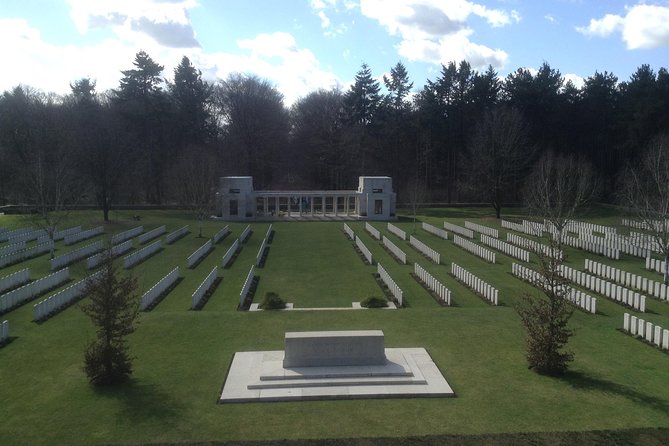
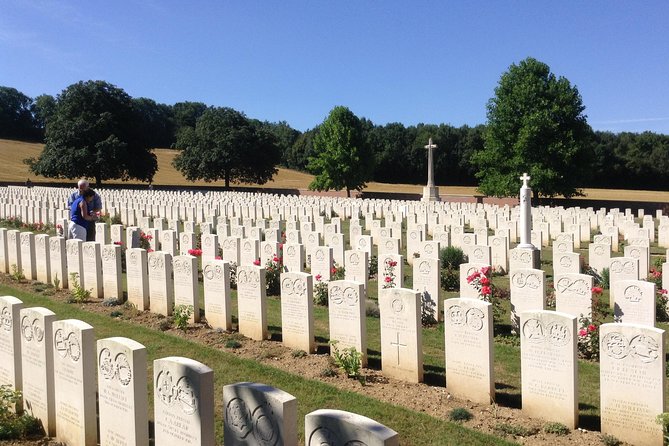
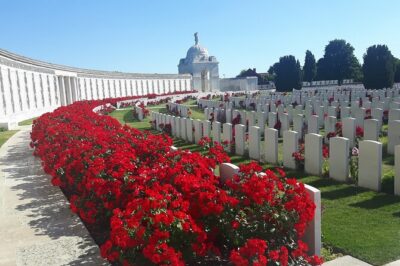
Tyne Cot Cemetery receives about 45 minutes. It is the largest Commonwealth War Graves Commission cemetery in the world, with about 12,000 soldiers buried there. Only around 3,000 of those graves have identified names, a reminder of how many men remained unknown after the fighting.
Two Australian Victoria Cross recipients are buried here. Their graves give you a specific point of focus, but the cemetery’s force comes from the sheer number of burials and the repeated absence of names.
You should expect this to be a quiet, reflective part of the day. The cemetery is not simply a place to take photographs and move on. It helps you grasp the cost of the Passchendaele fighting, especially after hearing about the ground, roads, artillery positions, and advances earlier in the tour.
Forty-five minutes is enough for a guided visit, though anyone tracing a particular soldier may want more time. Share names and units with Soren before the tour. His preparation can help turn a large cemetery into a personal destination.
John McCrae’s hospital site and the making of a poem
The John McCrae site takes about 30 minutes. Here you visit the hospital location where Lieutenant Colonel John McCrae composed In Flanders Fields.
The poem is familiar to many people, but the place gives it a setting. You can consider the medical work around the front, the deaths McCrae witnessed, and the way a short poem became tied to remembrance across the English-speaking world.
This stop works best as a pause between the large cemetery at Tyne Cot and the Menin Gate. It is less about battlefield movement and more about memory, grief, and the language people used to make sense of the war.
Soren’s approach, based on the available details, is not limited to dates and troop movements. He uses personal accounts and individual stories to connect the military events with the people caught inside them. That is particularly useful at a place associated with a poem rather than a major assault.
The Menin Gate and 55,000 missing names
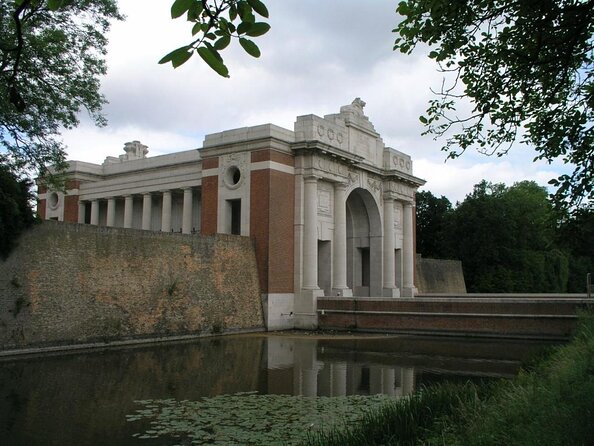
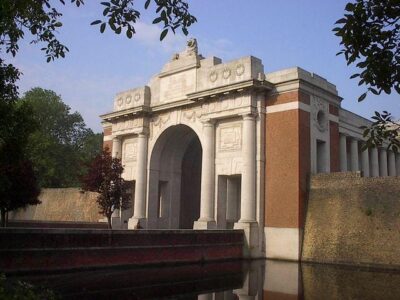
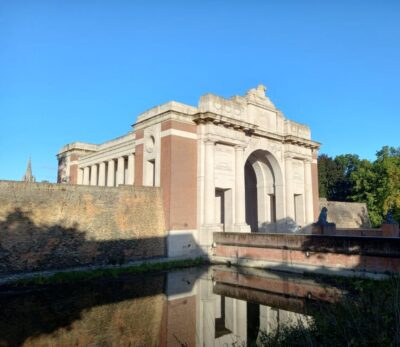
The Menin Gate Memorial takes about 20 minutes and provides the day’s powerful finish in central Ypres. You hear how the memorial came about and learn about the approximately 55,000 names of missing soldiers listed there.
The number is difficult to absorb until you see the names arranged across the memorial. Unlike a grave with a known identity, a name on the gate represents someone whose final resting place was never identified.
The Menin Gate also brings the tour back to the town itself. You have spent much of the day outside Ypres, following roads and fields connected with the fighting. Here, the war enters the city through architecture, remembrance, and the continuing presence of the missing.
The stop is only 20 minutes, so do not expect a long independent visit. It is a guided introduction rather than a full exploration of every inscription. If the memorial is a priority for you, you may want to return independently at another time.
Sanctuary Wood’s original trenches and small museum
Sanctuary Wood Museum is the only stop with an admission ticket included. You spend about 40 minutes seeing original First World War trenches and a small museum.
After so many reconstructed, marked, or memorialized sites, surviving trenches offer a rougher physical connection to the war. You can see the cramped defensive spaces and compare them with the grand scale of cemeteries and memorials.
The museum is described as quaint rather than large. That is useful to know. This is not a major national collection with hours of exhibits. It is a compact, personal stop that fits into a day focused on walking the ground.
The museum visit also gives you a change of pace near the end of the tour. You move from open sites and cemeteries into a place where original wartime remains are the main attraction.
Price, pickup, and the real value of a private day
The price is $420.49 per person, and at least two people are required. For two, the advertised cost comes to $840.98 before any personal spending on lunch.
That is expensive compared with a large group excursion, but direct comparison can be misleading. You receive about eight hours with a private guide, hotel pickup from selected Ieper hotels, bottled water, transport between widely separated sites, and a route that can be adapted to your party.
The value is strongest if you have family history to investigate. Soren has researched individual ancestors for guests, connected cemetery visits to family members, and followed up with links to books, films, and podcasts. That preparation can save you hours of searching and make a visit far more meaningful.
For two people with only a general interest in military history, the cost may be harder to justify. For a family group, a small party sharing the fee, or anyone visiting graves connected to an ancestor, the private format makes more sense.
Lunch is not included. Plan for that when considering the eight-hour schedule. The supplied details do not specify a restaurant stop, so ask about lunch arrangements before booking if you want a sit-down meal during the day.
Pickup is available for Ieper-based visitors only on this tour, with a 9:00 am start. If you need to begin in Lille, Arras, or Bruges, you must choose one of the provider’s other listings. The tour is offered in English.
Who should book this tour
I would choose this tour if you want the battlefield sites explained rather than simply photographed. It is especially well suited to:
- People tracing a relative who served or died in the Ypres area
- Visitors interested in Australian actions during the First World War
- Small groups who want a private pace and flexible questions
- First-time visitors who would struggle to connect the scattered sites alone
- People who want both major memorials and less obvious details such as bunkers, craters, and headquarters sites
I would think twice if you want a short, low-cost introduction, dislike cemetery visits, or prefer to spend most of the day walking. The schedule covers a lot of ground, but several stops are brief or viewed from the vehicle.
The tour is suitable for most people, and service animals are allowed. It is near public transportation, though the included pickup is limited to Ieper-based locations. Confirmation arrives within 48 hours, subject to availability.
Should you book the Ypres Christmas Truce and Passchendaele tour?
Book it if the First World War is a central reason for your visit to Ypres, especially if you have a family name, regiment, or cemetery to find. Soren’s ability to adjust the day and research personal connections is the strongest reason to pay for a private guide.
The route also works for serious history fans who want Messines, Hill 60, Polygon Wood, Tyne Cot, John McCrae’s site, and the Menin Gate in one full day. You will see the main landmarks, but you will also hear about the ground between them.
Skip it if the $420.49 per-person price is beyond your budget or if you only want the town’s memorials. In that case, you can focus on Ypres itself and visit the Menin Gate separately. For a small group seeking a personal, detailed connection to the Ypres Salient, this is a strong use of one day.
FAQ
Where does the tour begin?
The tour starts at 9:00 am with pickup from Ieper-based locations and selected hotels.
How long does the tour last?
The experience lasts approximately eight hours.
How many people are required to book?
A minimum of two guests is required.
Is the tour private?
Yes. Only your group participates in the activity.
What language is the tour offered in?
The tour is offered in English.
Is lunch included?
No. Lunch is not included in the price.
What is included in the tour?
Bottled water and admission to the trench museum are included. Pickup from selected Ieper hotels is also offered.
Can I start the tour in Lille, Arras, or Bruges?
Not with this specific Ieper-based tour. The booking information directs visitors who want to start in Lille, Arras, or Bruges to the provider’s other listings.
More Christmas in Ypres
Just added around Ypres
- In Flanders Fields and Passchendaele Grand Tour★ 5.0 · 25 reviews
- From LIlle or Bruges, Christmas Truce to Passchendaele Ypres 1 day WW1 private★ 5.0 · 5 reviews
- e-Scavenger hunt Ypres: Explore the city at your own pace★ 4.5 · 6 reviews
- PRIVATE Australian Western Front Battlefields 3-Day Tour Ypres to Amiens★ 5.0 · 3 reviews
- From Ypres 4hr Christmas Truce and Monster Mines of Messines PRIVATE Tour★ 5.0 · 5 reviews
- Discover Tournai while playing! Escape game – The alchemist★ 4.0 · 3 reviews
- Full Day Canadian WW1 Vimy and Somme Battlefield Tour from Ypres★ 5.0 · 6 reviews
- From Ypres: WWI Battlefields Private Tour★ 5.0 · 25 reviews
Flanders Fields WWI Tours, compared.
Great War Flanders Fields Minibus Tour w/ Lunch
Read our review →
Flanders Fields Remembrance Tour from Brussels
Read our review →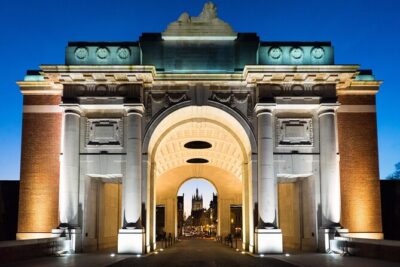
In Flanders Fields and Passchendaele Half Day Morning Tour
Read our review →
In Flanders Fields and Passchendaele Grand Tour
Read our review →Browse the lists this tour appears in